These are short, direct answers to the questions Canadians ask most about the water line to their house: whether it is lead and what to do about it, who owns and pays for which part, why pressure is low, how deep it is buried, what it is replaced with, whether it can be done without a trench, and what it costs. Each answer links to the guide that goes deeper.
- Most answers depend on your utility: check the city programs page for yours.
- Lead questions start with Health Canada's 5 µg/L guideline and a look at the pipe.
- Pressure questions start with a gauge and a bucket, not a new pipe.
01 /How to use these answers
Answers are grouped loosely: lead first, then ownership and money, then pressure, frost and materials, then the replacement itself. City-specific facts come from each utility's own pages as checked in September 2026; health facts come from Health Canada. For anything that depends on your address, the city programs page and the two free tools, the Lead Water Line Check and the Low Water Pressure Diagnosis, are the next step.
Terms you meet in quotes and utility letters are defined in the glossary. If your question is not here, send it with your details and the desk will reply.
FAQAll questions
What is Health Canada's limit for lead in tap water?
The maximum acceptable concentration is 0.005 mg/L, which is 5 µg/L or 5 parts per billion, set in 2019. See testing water for lead.
Until what year were lead water service pipes installed in Canada?
Health Canada says the National Plumbing Code accepted lead for service pipes until 1975. Many cities stopped much earlier; see lead water service lines.
How can I tell if the pipe coming into my basement is lead?
Lead is dull grey and soft, shows shiny silver when scratched lightly, a magnet will not stick, and joints are often a rounded bulb. See how to identify a lead water pipe.
What should I do today if I think my service is lead?
Run the cold tap until it is cold after water has sat, use cold water for drinking and cooking, use a filter certified for lead reduction, and book a test.
Why is replacing only the city's half of a lead line a problem?
Disturbed lead left in place can shed particles; Health Canada says for two to three months, and its guidance says partial replacements are generally not recommended.
Which Canadian utility pays for both sides of a lead replacement?
Halifax Water's Get the Lead Out program replaces both sides at no cost to the owner, up to $20,000 per replacement, and aims to finish by 2038.
Is replacing a private lead line mandatory anywhere in Canada?
Yes. Montréal makes it mandatory, Québec City requires it within four years of replacing its side, and Regina requires it when the City replaces its side.
Where does my responsibility for the water line start?
Usually at the property line or the curb stop near it. Each utility sets the rule; see who pays for water line repair.
Who fixes a leak between the curb stop and my house?
Usually the owner, as that section is private in most cities. A leak at or beyond the curb stop is usually the utility's.
Does my house insurance pay for a new water service line?
Standard policies generally do not pay to replace a worn-out buried pipe. Some insurers offer service line coverage; ask for the wording in writing.
What does it cost to replace the water line to a house?
Published figures run from about $2,000–$3,000 for a typical Toronto private side (2020) to $1,200–$1,400 per metre in Montréal (2022–2025). See the cost page.
Why is the water pressure weak in every tap?
Check the main shut-off, the pressure-reducing valve and any softener first, then scaled pipe and the service line. See low water pressure.
What water pressure should my house have?
The City of Calgary suggests 40 to 60 psi; the plumbing code calls for a pressure-reducing valve where static pressure at a fixture may exceed 550 kPa, about 80 psi.
How do I measure my water pressure at home?
Put a hose-thread gauge on a hose bib or laundry tap, make sure nothing else runs, and open the tap. Time a bucket fill at the same tap to measure flow.
What is a pressure-reducing valve and do I have one?
A brass valve after the meter that lowers high street pressure. Calgary says homes built after 1990 in areas over 80 psi have one. See pressure-reducing valves.
Why does my water slow down during a cold snap?
A gradual drop in deep cold can mean the service is starting to freeze. Call the utility early. See frost and water line depth.
How deep are water lines buried on the prairies?
Deep: Calgary requires 8.5 feet of cover, EPCOR puts new Edmonton services 2.59–2.89 m below grade at the property line, and Regina calls for 2.7 m.
Should old galvanized water pipes be replaced?
Usually, once flow falls or rust appears; they corrode shut from the inside and can hold lead. See galvanized water lines.
Do I have to replace Poly-B plumbing?
The City of Calgary says it is not necessary if you have had no problems, though your insurer may have its own view. See Poly-B water lines.
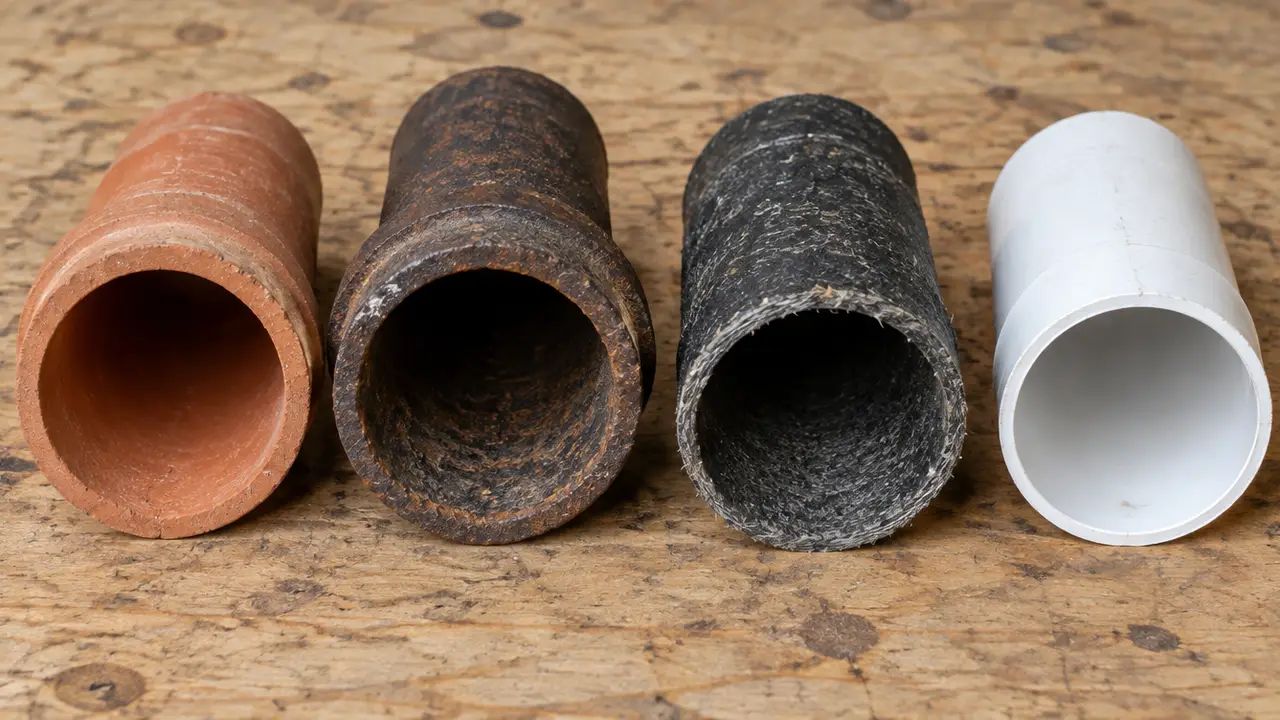
What pipe is used for a new water service?
Type K copper, polyethylene or PEX, as the utility and provincial code approve, at least 3/4 inch. See copper, PEX or polyethylene.
Can the water line be replaced without trenching the lawn?
Often, by pulling, splitting or boring between a pit at the curb stop and one at the house. See trenchless water line replacement.
How long will I be without water during a service replacement?
Usually part of one day for a single house, while the old line is cut and the new one connected and tested.
Do I need a permit to replace a water service?
In most municipalities, yes, and several lead programs require it before work starts. See the replacement process guide.
Is WaterMainReplacement.ca a contractor?
No. It is part of the HAUSE network, an independent information and service-request network; it does not do the work.