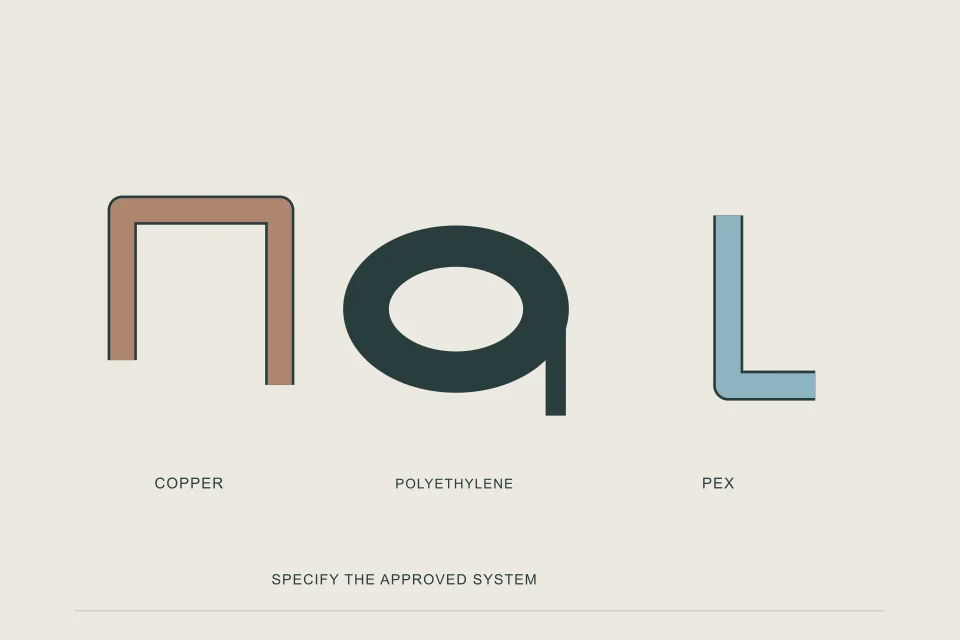
A new water service in Canada is usually type K copper (ASTM B88), polyethylene made to CSA B137.1, or PEX made to CSA B137.5, whichever the utility and provincial plumbing code approve. Copper is rigid-ish, conducts electricity and can be thawed electrically; polyethylene and PEX come in long coils with few buried joints and suit trenchless pulls. The service must be at least 3/4 inch, and some cities require 1 inch.
- Your utility's approved-materials list decides the choice, especially for the part it will own.
- EPCOR names copper and polyethylene as today's preferred service materials.
- The plumbing code minimum for a water service is 3/4 inch; Calgary's infill rules call for 1 inch.
- Plastic services need a check valve at the building end where the pipe is rated for cold water only.
- Replacing a metal service with plastic can affect the house's electrical grounding; have an electrician confirm it.
01 /Which materials are used for water services today?
Three families cover almost every new house service in Canada. Each is made to a named standard, and the print line on the pipe states it. The utility and the provincial plumbing code decide which are allowed for a buried service in your area and at what size, so start with them rather than with a preference.
| Material | Standard | Form | Joints underground |
|---|---|---|---|
| Copper, type K | ASTM B88 (the thickest wall of the K, L and M types) | Soft coils for services | Flared or compression fittings where approved; ideally none between the ends |
| Polyethylene (PE) | CSA B137.1, cold water pressure services | Long coils | Compression or fused fittings; few or none on a short run |
| PEX (cross-linked PE) | CSA B137.5, pressure applications | Coils | Crimp or expansion fittings where approved |
EPCOR says copper and polyethylene are the preferred materials for water service lines today. Many utilities also dictate the material of their own side, and some install their side themselves, so the private side may be your only real choice. The glossary defines the terms on a pipe's print line.
02 /How do copper, polyethylene and PEX compare?
None of these is a universal winner. Copper has the longest track record and is easy to find again with a locator; plastic is quicker to pull through a bored hole and avoids metal corrosion. Soil and water chemistry, depth, the method, and the utility's rules usually settle it.
03 /What size should a new water service be?
At least the code minimum, and big enough for the house's peak demand over the service length. The plumbing code says water service pipes are sized according to peak demand flow but not less than 3/4 inch. Some municipalities set a larger minimum: Calgary's infill rules say water service piping must be a minimum of 1 inch (25 mm). A long service, a house with several bathrooms, a secondary suite or irrigation all push the size up.
- Match the utility side: a larger private service helps little if the curb stop and public side are small; ask whether the utility will upsize its part.
- Match the meter: the meter and its fittings must suit the new size.
- Think about the future: a basement suite or laneway home added later may need more than the house does today.
Size is also a pressure question: an undersized service shows up as flow that collapses when several fixtures run. See low water pressure.
04 /What code details come with a plastic service?
Two details matter most. First, the plumbing code requires a check valve at the building end of a water service where the pipe is a plastic suitable for cold water use only, so that heated water cannot flow back into it. Second, where a check valve or a pressure-reducing valve closes the house off from the main, the code requires protection against thermal expansion, usually an expansion tank near the water heater.
Grounding is the third detail. In older homes the metal water service was often part of the electrical grounding system. When a metal service becomes plastic, have an electrician confirm the grounding still meets the electrical code; a quote should mention it. More on valves is in pressure-reducing valves.
05 /Which material suits a trenchless replacement?
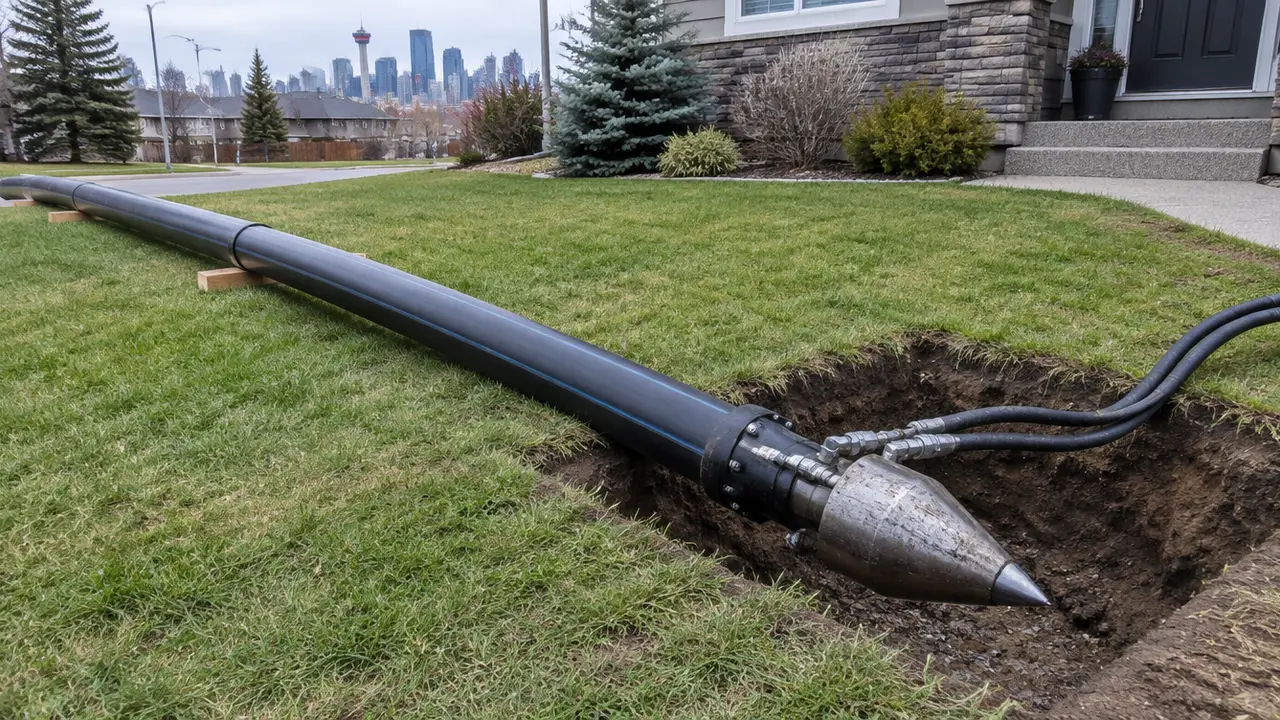
Flexible plastic usually, because it follows a bored or pulled path easily and arrives in one continuous length. Copper can also be pulled, particularly soft type K, but it is less forgiving of tight bends. Bursting and splitting heads open the old pipe and pull the new one in behind; boring makes a fresh path. The methods, and which old materials suit which, are in trenchless water line replacement. Bursting in depth, including potable pipe ratings, is covered on PipeBursting.ca.
| Method | Usual new pipe | Note |
|---|---|---|
| Open trench | Any approved material | Depth and restoration drive cost |
| Pull-out and pull-in | Polyethylene, PEX or soft copper | Follows the old path exactly |
| Split or burst | Polyethylene | Old metal is split and pushed aside |
| Bore a new path | Polyethylene or PEX | Old line abandoned or cut off |
06 /What should the quote say about materials?
- The material, the standard it is made to, and the size.
- Whether the utility has approved that material for its side and yours.
- The fittings at the curb stop and at the entry, and whether any buried joints are planned.
- The new main shut-off valve and, for plastic, the check valve and tracer wire.
- A note on electrical grounding if a metal service becomes plastic.
See the cost page for the drivers, and the replacement process guide for permits and the work day. When you are ready, send your details.
07 /What about the utility's side of the service?
The public side is the utility's choice. Many utilities specify one material for the part they own, and some install their side themselves or through a listed contractor, as Halifax Water does for the public side of lead replacements. When you replace your side, the joint between the two materials is usually made at or near the curb stop, and the utility will want it made its way.
- Ask what the utility will install on its side, and at what size, before choosing yours.
- Ask about the transition fitting at the curb stop: which fitting, and who supplies it.
- Ask whether the utility requires a tracer wire or a record drawing for a plastic private side.
- Ask about a larger service if you are adding a suite or bathrooms; the utility side and the curb stop may also need upsizing, and the utility decides that.
A mismatch is common in older neighbourhoods: a new copper utility side joined to an old private line, or the reverse. That is fine for flow if the sizes match, but where the old side is lead or galvanized it is a partial replacement, which Health Canada says is generally not recommended. See lead service line replacement.
FAQQuestions people ask
Is copper or PEX better for a water service line?
Neither is best everywhere. Your utility's approved list decides first; after that, depth, method, soil and water chemistry, and the need to locate or thaw the line later settle it.
What is type K copper?
The thickest-walled of the three copper water tube types in ASTM B88, used in soft coils for buried services.
What size water line does a house need?
At least 3/4 inch under the plumbing code, sized for peak demand. Some cities, such as Calgary for infill, require 1 inch.
Does a plastic water service affect my electrical ground?
It can, if the old metal service was part of the grounding. Have an electrician confirm the grounding when the service changes to plastic.
Can a frozen plastic water line be thawed?
Not electrically, since plastic does not conduct. Utilities and specialists use other methods; call your utility.
Is polyethylene the same as PEX?
No. PEX is polyethylene that has been cross-linked, made to CSA B137.5; ordinary polyethylene service pipe is made to CSA B137.1. They use different fittings.
Can I choose the material for the utility side?
Usually not. The utility specifies, and often installs, its own side; your choice is normally the private side, within the utility's approved list.
NETWORKGo deeper across the HAUSE Sewer network
The worst trees for sewer lines, ranked for Canadian yards
The worst trees for sewer lines in Canada: willow, poplar, silver maple, Manitoba maple and elm ranked by root risk, with distances and what to do next.
PipeCleaning.caPipe Method Matcher: which cleaning methods suit your pipe
Pipe Method Matcher: enter your house era, pipe material and symptom to see which pipe cleaning methods are recommended, safe with conditions, or avoid.
SewerJetting.caIs hydro jetting safe for PVC and ABS drain pipe?
Can hydro jetting damage PVC or ABS pipe? What plastic lines tolerate, where they are weak (joints, fittings, bellies, heat) and how to jet them safely.