A lead water service line is a pipe made of lead that brings drinking water from the main into a house. Health Canada says lead service lines are likely the most significant source of lead in drinking water where they exist, and that children, infants and fetuses are most at risk. The national plumbing code allowed lead service pipe until 1975. Health Canada calls replacement the best permanent solution.
- Health Canada's guideline for lead in drinking water is 0.005 mg/L (5 µg/L), set in 2019.
- Lead pipe was allowed for services until 1975 and lead solder until 1986, so older homes can have both.
- Owning a house with a lead service is not illegal, but new lead pipe is no longer installed, and some cities now require replacement.
- Lead levels rise the longer water sits in contact with lead pipe, which is why first-draw water carries the most.
- Until replacement, run the cold tap until it is cold and use a filter certified for lead.
01 /Why were lead pipes used for water services?
Lead is soft, easy to bend around obstacles and resists the kind of corrosion that eats through steel, so for decades it was a practical choice for the short pipe from the main to a house. Health Canada notes that the National Plumbing Code of Canada considered lead an acceptable material for the pipes that bring water to homes until 1975. Most cities stopped earlier. Toronto, Hamilton, Guelph and Winnipeg say houses built before the mid-1950s may have lead; Ottawa says lead was used up until the 1950s; Calgary says its lead services date mainly from 1939 to 1947, when copper was scarce during the Second World War.
| City | Era the utility names |
|---|---|
| Calgary | Mainly 1939–1947 |
| Saskatoon | Before 1950 |
| London (Ont.) | Little concern after 1952 |
| Toronto, Hamilton, Guelph, Winnipeg | Before the mid-1950s |
| Ottawa | Up until the 1950s; little or no risk after 1958 |
| Regina, Halifax, Edmonton | Before 1960 |
| Montréal | Screens buildings built before 1970 |
| Québec City | Program covers buildings built before 1980 |
| Anywhere | National code allowed lead service pipe until 1975 |
Lead did not only go into service lines. Health Canada says the plumbing code allowed lead in solder until 1986, and EPCOR, quoting Health Canada, notes lead may also be found in brass and bronze fittings such as faucets and valves. A house built before about 1990 can therefore have lead sources inside even when the service itself is copper.
02 /Are lead water pipes dangerous?
They are a real exposure risk, especially for young children and during pregnancy. Health Canada says children, infants and fetuses are most at risk because of their developing brains, that lead exposure is linked to effects on neurological development and behaviour such as lower IQ in children, and that lead can pass from a pregnant mother to the fetus. It set the guideline, the maximum acceptable concentration, at 0.005 milligrams per litre in 2019, which it describes as one of the lowest in the world.
How much lead ends up in the glass depends on several things: how long the water stood in the pipe, the water's chemistry, whether the pipe has recently been disturbed, and the length of lead in the path. Many utilities add a corrosion inhibitor to reduce lead release: Toronto has used phosphate since 2014, Winnipeg orthophosphate since 2000, Hamilton since 2018, Halifax zinc orthophosphate. That lowers the levels; it does not remove the pipe.
03 /Are lead water pipes illegal in Canada?
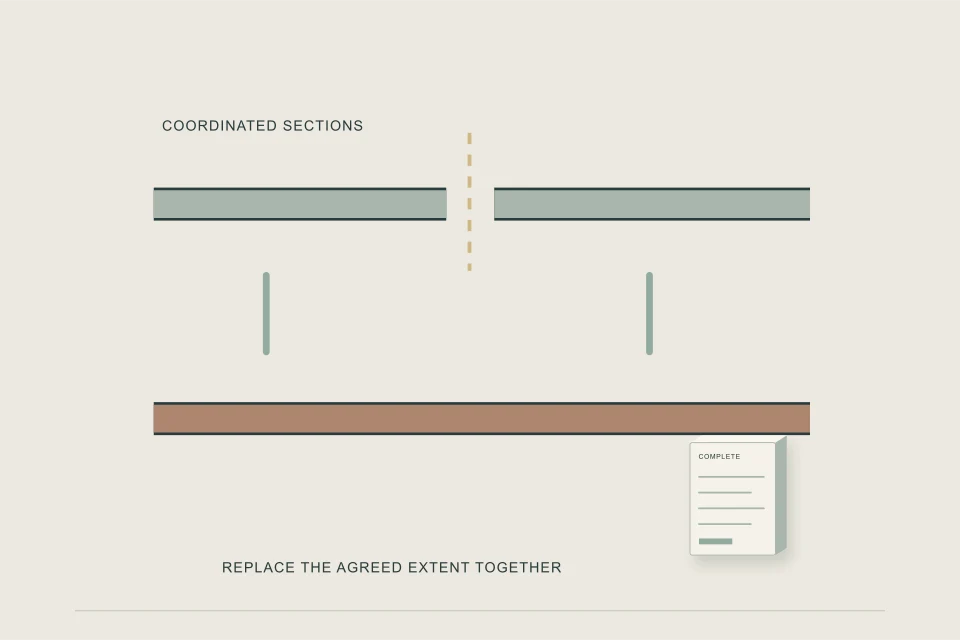
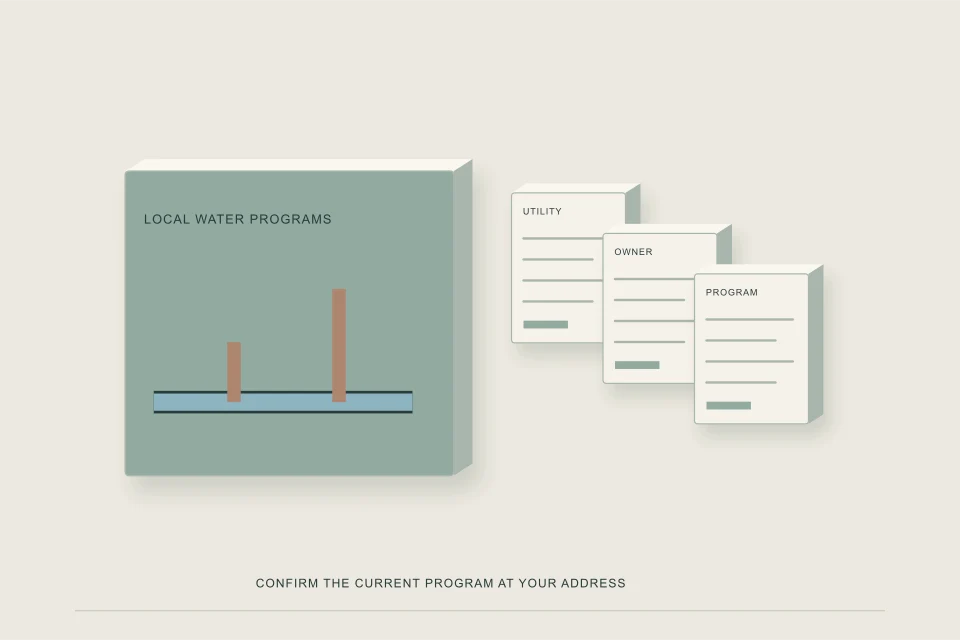
Having an existing lead service is not illegal in itself, but lead is no longer installed, and some cities now require owners to replace it. Montréal says replacing a private lead section is mandatory. Québec City's By-law R.V.Q. 2884 requires owners to replace a private lead connection within four years of the City replacing its side. Regina's Water Bylaw requires private lead connections to be replaced when the City replaces the adjoining City connection. Saskatoon replaces both portions together and does not allow partial replacement.
Elsewhere replacement is encouraged rather than required, often with help: grants in Guelph and Québec City, loans in Hamilton and London, full funding in Halifax. The comparison is on the city programs page. When you sell, a lead service can also come up in a buyer's inspection or a lender's questions, so knowing your status helps either way.
04 /How long do lead pipes last?
Physically, a long time, which is part of the problem: a lead line laid in the 1940s can still carry water today. Lead does not usually fail the way galvanized steel does, by rusting shut. Its problem is what it adds to the water, and what happens when it is disturbed. Street work, a nearby excavation, a meter change or a partial replacement can knock loose particles and scale, and Health Canada says particles may detach from remaining lead pipe for two to three months after a disturbance such as a change to the municipal pipe.
That is why programs work so hard to replace both sides together, and why Health Canada's corrosion guidance says partial replacements are generally not recommended. The lead service line replacement guide explains how full replacement is coordinated between the owner and the utility.
05 /What should I do if I think my service line is lead?
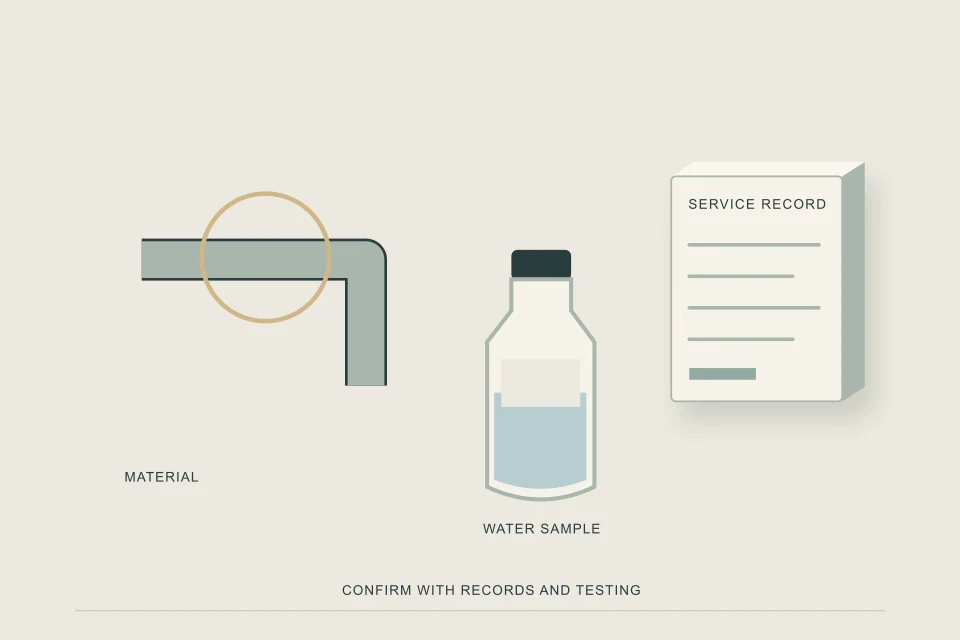
- Confirm the material
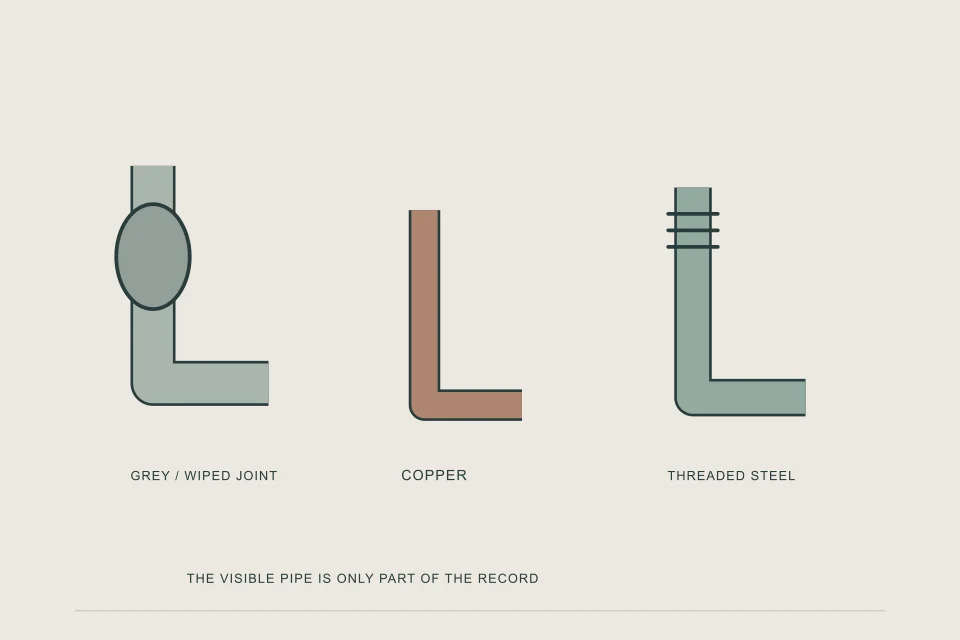
Look at the pipe where it enters, before the meter, and ask your utility for its record of the public side. The identification guide shows the checks.
- Reduce exposure now
Health Canada advises running the tap until it is cold, about one minute, after water has been sitting, and using cold water for drinking and cooking.
- Filter
Use a drinking water filter certified to the NSF standard for lead reduction, or bottled water, especially for infant formula.
- Test
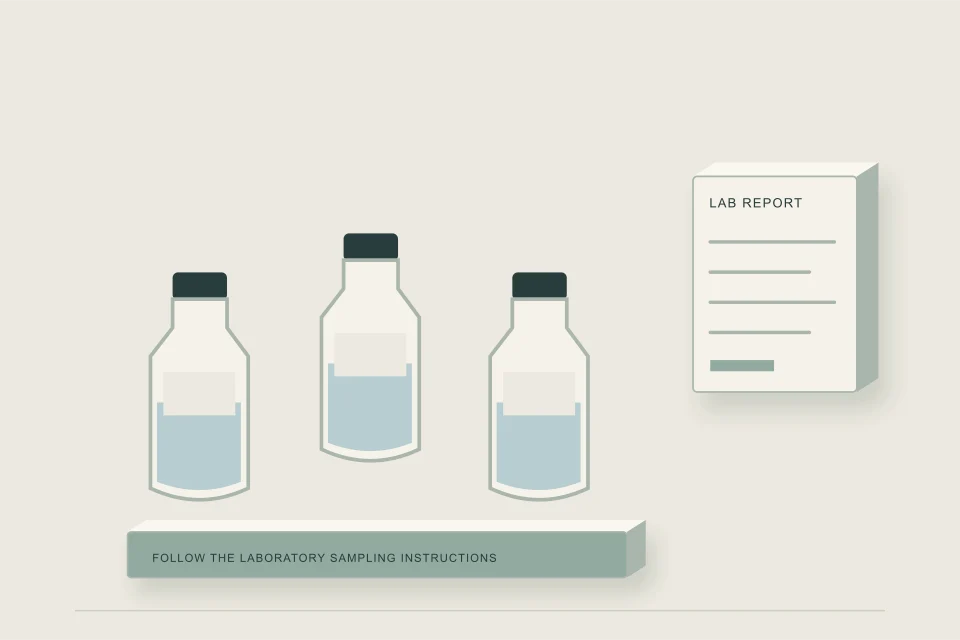
Many utilities test for free; otherwise use an accredited laboratory. See testing water for lead.
- Plan the replacement
Check your city's program before booking work, since several require approval or a permit first.
Health Canada is direct about the end goal: the best permanent solution for a lead service line is to have it replaced. Filters and flushing are interim measures. The Lead Water Line Check gives a likelihood for your home and your city's program in one result.
06 /Does a lead service line affect the whole house?
Yes. Every tap in the house is fed through the service, so lead from the service can reach any of them. It tends to be highest in the first water drawn after a long stagnation, such as first thing in the morning, and at the taps you use most for drinking. In any older home, use only cold water for drinking, cooking and formula, as Health Canada advises, and treat hot water as washing water.
- Run the tap until cold after water has sat for a few hours.
- Clean aerators regularly, since particles collect in the screens.
- Use a certified filter on the tap used for drinking, and change cartridges on schedule.
- Avoid disturbing the line; if street or yard work is planned near it, ask about flushing afterwards.
The cost of replacing a lead line, and the help available, are on the cost page. For quotes, send your details.
07 /What does a lead service mean when buying or selling a house?
It is a disclosure and budgeting question more than a deal-breaker, but it is better handled before conditions expire. A buyer can ask the seller and the utility about the service material, look at the pipe at the meter during the showing or inspection, and ask the utility whether its side is on record as lead. In Montréal the City's replacement charge stays with the building if it is sold, which a buyer of a pre-1970 plex should know about.
- Ask the utility what its records show for the public side at the address.
- Photograph the entry pipe during the inspection.
- Check the local program: some cities require replacement, and some attach costs to the property.
- Get a quote for the private side before your conditions expire, if lead is likely.
Sellers who have replaced a lead line should keep the permit, invoice and test results; they answer the question quickly. The city programs page shows what each city requires.
FAQQuestions people ask
When did Canada stop using lead water service pipes?
Health Canada says the National Plumbing Code accepted lead for service pipes until 1975. Many cities stopped earlier, often in the 1950s.
Is boiling water a way to remove lead?
No. Boiling does not remove lead. Use cold water run until cold, and a filter certified for lead reduction.
Can I shower in water from a lead service line?
The main concern with lead in water is drinking and cooking. For health questions specific to your household, ask your public health unit.
Should lead water pipes be replaced?
Health Canada calls replacement the best permanent solution. Replace both the public and private sides together wherever possible.
Do lead pipes turn green or rust?
No. Lead is a dull grey that shows shiny silver when scratched. Green staining is typical of copper, and rust of steel.
NETWORKGo deeper across the HAUSE Sewer network
Is sewer backup dangerous? Health risks, what it smells like and what it looks like
Is sewer backup dangerous? How sewage can make you sick, what sewer backup smells and looks like, when the smell is harmful, and who should stay away.
SewerInspector.caSewer scope inspections in Edmonton: what to expect and who to call
Sewer scope and sewer line inspection in Edmonton: what mature and newer neighbourhoods show on camera, cold and clay soils, elms, EPCOR and 311 checks.
SewerJetting.caHow to use a drain jetter: a safety-first walkthrough for rental units
How to use a drain jetter or rented sewer jetter: setup, nozzle choice, feeding and pulling hose, and the stop rules that help prevent injection injuries.