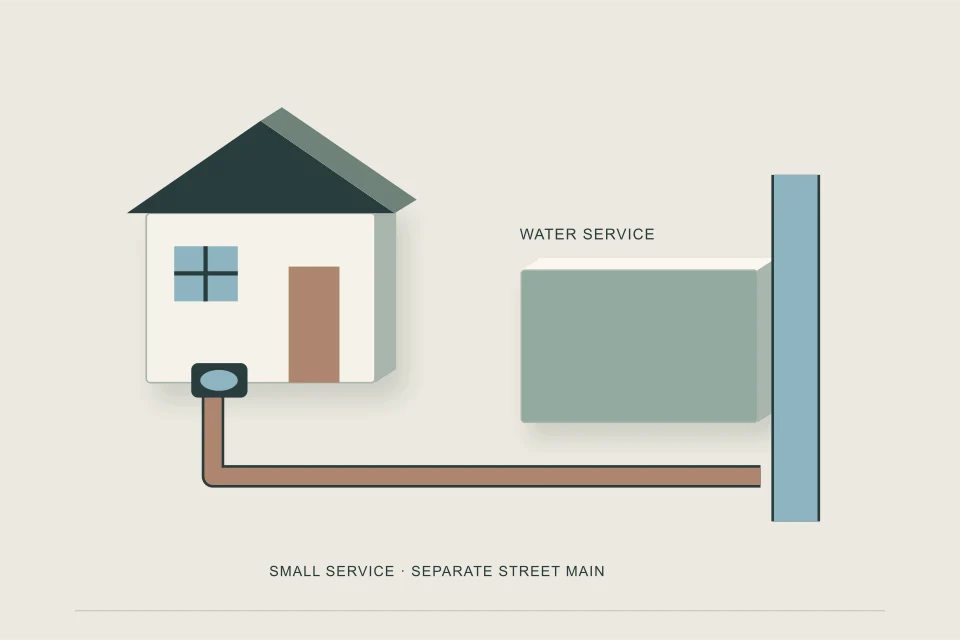
A water service line is the buried pipe that carries drinking water from the municipal water main to a building. It starts at a corporation stop on the main, passes a curb stop that lets the utility shut off one property, runs below frost to the foundation, and ends at the main shut-off valve and the meter inside. The utility usually owns one end and the property owner the other.
- A service has three valves in three places: the corporation stop on the main, the curb stop near the property line, and the main shut-off inside.
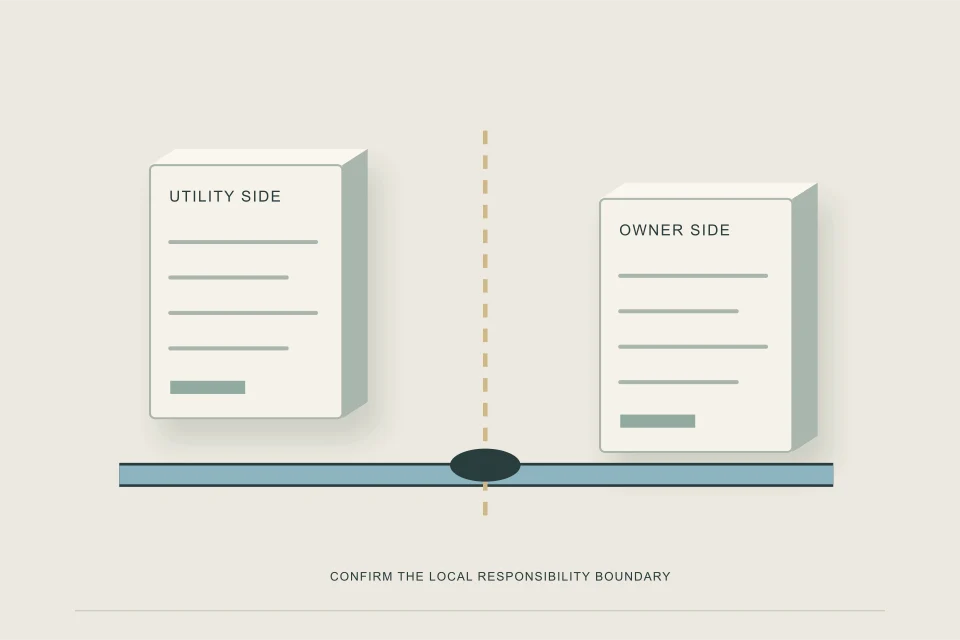
- Ownership usually changes at the property line or the curb stop, and each utility sets its own rule.
- Services are buried below frost, which in prairie cities means well over two metres.
- The plumbing code sets a minimum service size of 3/4 inch, and some cities require more.
- The material underground can differ from the pipe you see in the basement.
01 /What are the parts of a water service line?
A house water service is a short pipe with a lot of named parts, and each part matters when something goes wrong. From the street inward, the parts are the water main, the corporation stop, the service pipe on public land, the curb stop and its box, the service pipe on private land, the foundation entry, the main shut-off valve, the meter and, in many homes, a pressure-reducing valve.
| Part | Where it is | What it does | Usually owned by |
|---|---|---|---|
| Water main | Under the street or lane | Feeds every service and hydrant on the block | Utility |
| Corporation stop | On top of the main | Connects the service to the main; operated only by the utility | Utility |
| Service pipe, public side | Under the boulevard | Carries water to the property line | Utility |
| Curb stop and curb box | Near the property line | Shuts off water to one property from the surface | Utility (even when on private land, in some cities) |
| Service pipe, private side | Under your yard | Carries water to the foundation | Owner |
| Main shut-off valve | Inside, where the pipe enters | Lets you shut off the whole house | Owner |
| Meter | Inside, near the shut-off | Measures use | Utility |
| Pressure-reducing valve | After the meter, where fitted | Lowers high street pressure | Owner |
The plumbing code requires an accessible shut-off valve as close as possible to where the water service pipe enters the building, which is why the main shut-off sits right at the wall. It also requires a check valve at the building end where the service is a plastic suitable for cold water only, so that hot water cannot back into it.
02 /Who owns the water service line?
Usually two parties, split at or near the property line. The utility owns the main, the corporation stop and the pipe to the split; the owner owns the rest into the house. Where exactly the split falls is set locally, and it changes who pays for a leak, who replaces lead, and who has to be called first.
- At the property line: Toronto, Hamilton, Montréal, Regina, Saskatoon, London and Calgary. Montréal counts the private section from the property line to the interior shut-off valve.
- At the shut-off valve near the property line: Ottawa and Winnipeg describe the split at the valve; Winnipeg says the City owns the valve itself.
- Utility owns the valve on private land: Calgary says its service valve is not always on the City's side but the City owns it; EPCOR in Edmonton owns the curb stop and the meter.
Each city's rule, with the source, is on its page under city programs. For leaks and insurance, see who pays for water line repair.
03 /How deep and how big is a water service?
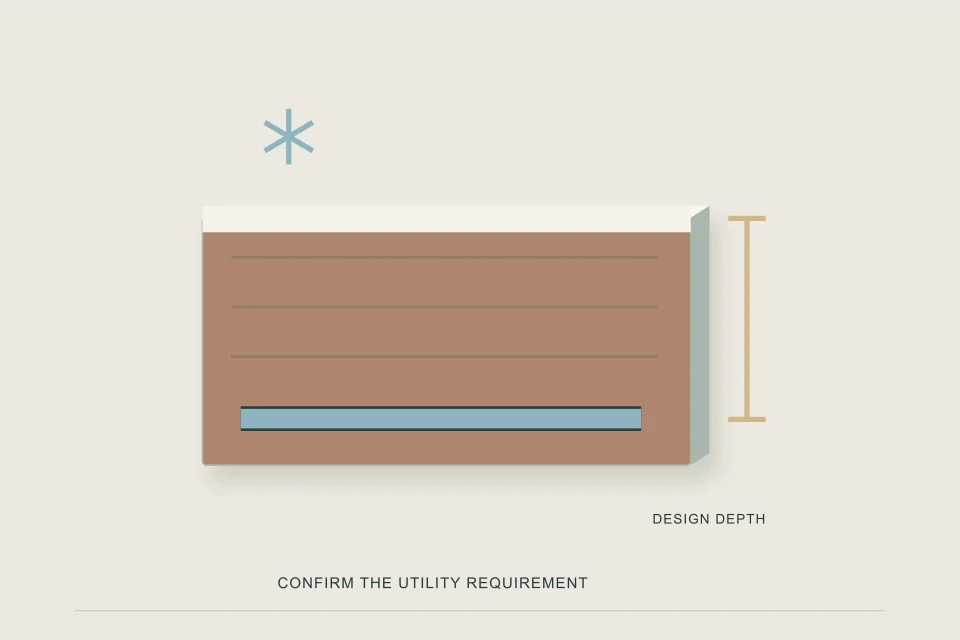
Deep enough to stay below frost, and at least 3/4 inch in size. The plumbing code says water service pipes are sized for peak demand but not less than 3/4 inch. Some cities set more: Calgary's infill rules call for a minimum of 1 inch (25 mm). Depth is set locally because frost varies so much across Canada.
| City | Rule | Source |
|---|---|---|
| Calgary | 8.5 ft (about 2.59 m) of earth cover over water services | City infill plumbing rules |
| Edmonton | 2.59–2.89 m below finished grade at the property line | EPCOR Water Service Guidelines, May 2023 |
| Regina | At least 2.7 m of cover over the full service | City construction specification |
| Winnipeg | Insulate services where cover will be under 2.1 m | City specification CW 2110, May 2023 |
A service laid shallower than the rule, or one that rises over an obstruction, is where freezing starts. The frost depth guide explains why frost goes deeper under driveways than under lawns.
04 /What is a water service line made of?
It depends on when it was laid. Health Canada notes the National Plumbing Code accepted lead as a material for the pipes that bring water to homes until 1975, and each city's lead era is narrower than that. Galvanized steel was common in houses built before 1960 by the City of Calgary's account. Copper has been the long-standing choice, and polyethylene and PEX are common in newer work. EPCOR names copper and polyethylene as the preferred materials today.
The buried pipe and the pipe you see can differ. A plumber may have replaced the metre inside the wall and joined it to the old buried line, so copper at the meter does not prove a copper service. The materials guide compares what goes in today, and how to identify a lead water pipe explains what to check.
05 /How does water pressure reach the tap?
Pressure is set by the utility's system, mostly by the height of its reservoirs and the pumps feeding each pressure zone. Calgary, for example, manages pressure zones across an elevation range of almost 300 metres. The service line then costs a little pressure to friction on the way in, more if it is long, narrow or scaled, and the house plumbing costs more again. A pressure-reducing valve deliberately lowers pressure where the street supply is high; the plumbing code requires one where static pressure at a fixture may exceed 550 kPa.
That is why a problem with the service line usually shows up as weak flow when several taps run, not as weak pressure at a single tap. The low water pressure guide explains how to tell the difference, and the Low Water Pressure Diagnosis ranks the causes for your symptoms.
06 /When does a water service line need replacing?
The usual reasons are material, leaks, flow and freezing. A lead line is the strongest reason, because of the health risk; the lead service line guide explains why. A galvanized line that has scaled up will keep losing flow. A service that leaks repeatedly, or one that freezes because it was laid too shallow, is often cheaper to replace than to keep fixing. And a house being renovated for more bathrooms or a suite may need a larger service to carry the new demand.
- Find out what the line is made of and who owns which part.
- Check whether your city has a program, and what it requires before work.
- Get written quotes that state the method, pipe, length, depth and restoration.
- Follow the replacement process from locates to flushing.
For costs, see the cost page. For quotes, send your details.
FAQQuestions people ask
What is the difference between a water main and a water service line?
The main is the public pipe under the street that feeds the whole block. The service line is the smaller pipe that branches off it to one building.
What is a curb stop?
A buried valve on the service line near the property line, reached through a curb box from the surface, that the utility uses to shut off water to one property.
What size is a residential water service line?
The plumbing code minimum is 3/4 inch, sized up for demand. Some cities require more; Calgary's infill rules call for at least 1 inch.
Where is my main water shut-off valve?
Usually right where the service enters the house, near the floor, before or next to the meter. Utilities also say to look near the water heater.
Is the water meter mine?
Usually not. Most utilities own the meter even though it sits inside your house.
Can I turn the curb stop off myself?
Generally no. In most cities the curb stop belongs to the utility, which operates it with a long key through the curb box. Use your main shut-off inside, and call the utility if the curb stop needs turning.
Why does the service line enter at the front of the house?
Because the main is usually under the street in front. In lane-serviced neighbourhoods the main, the curb stop and the entry can all be at the back.
NETWORKGo deeper across the HAUSE Sewer network
Sewer line replacement cost by city: why local quotes differ
Sewer line replacement cost by city: why Calgary, Edmonton, Regina and other Canadian markets quote differently, GST/HST by province, and local drivers.
SewerCleaners.caFats, oils and grease: how FOG builds up in sewer lines and how to stop it
How fats, oils and grease (FOG) build up in sewer lines, why hot water and soap fail, how sewer cleaners remove grease, and kitchen habits that prevent it.
SewerRoots.caSewer-safe trees and shrubs to plant near a sewer line
Sewer-safe trees and shrubs for Canadian yards: small, slow, prairie-hardy species to plant near sewer lines, what to put over the trench, and what to avoid.