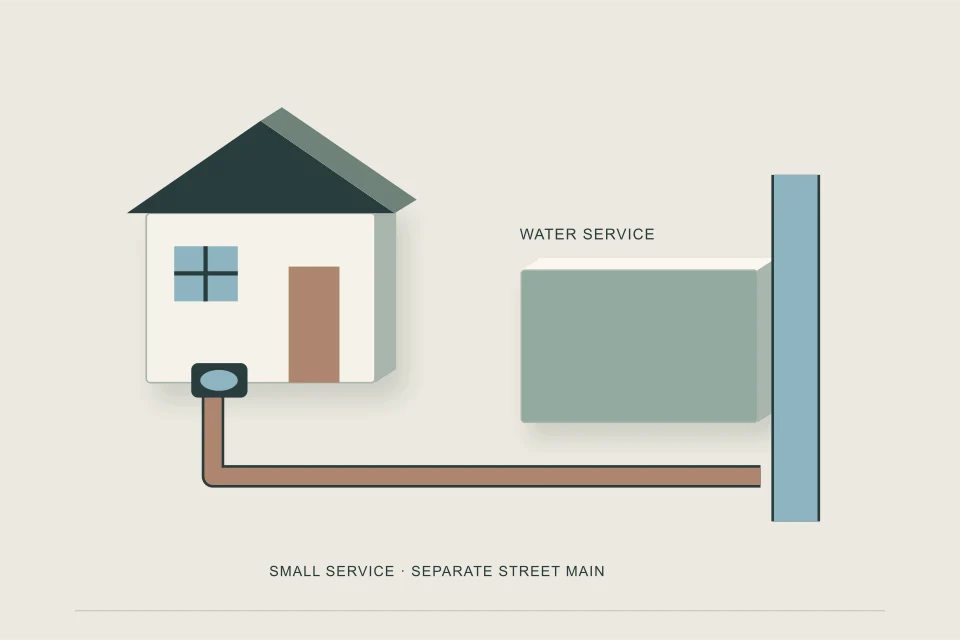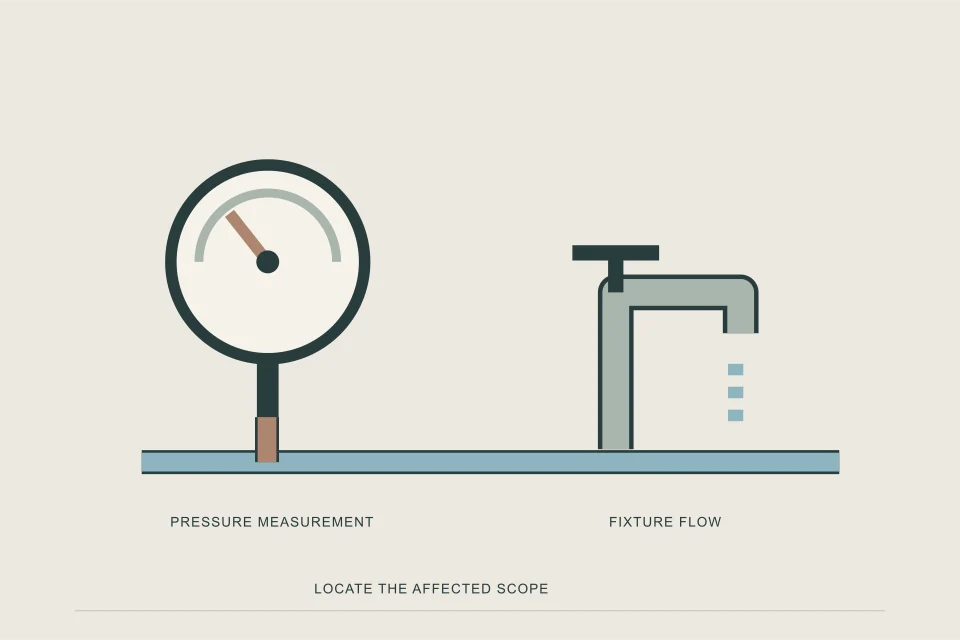
Low water pressure throughout a house usually comes from one of six places: a main shut-off valve not fully open, a failing pressure-reducing valve, scaled galvanized pipe, a narrow or scaled service line, a leak, or the utility's own system. One weak tap is usually its aerator or valve. Measure static pressure at a hose bib and time the flow into a bucket to tell pressure problems from flow restrictions.
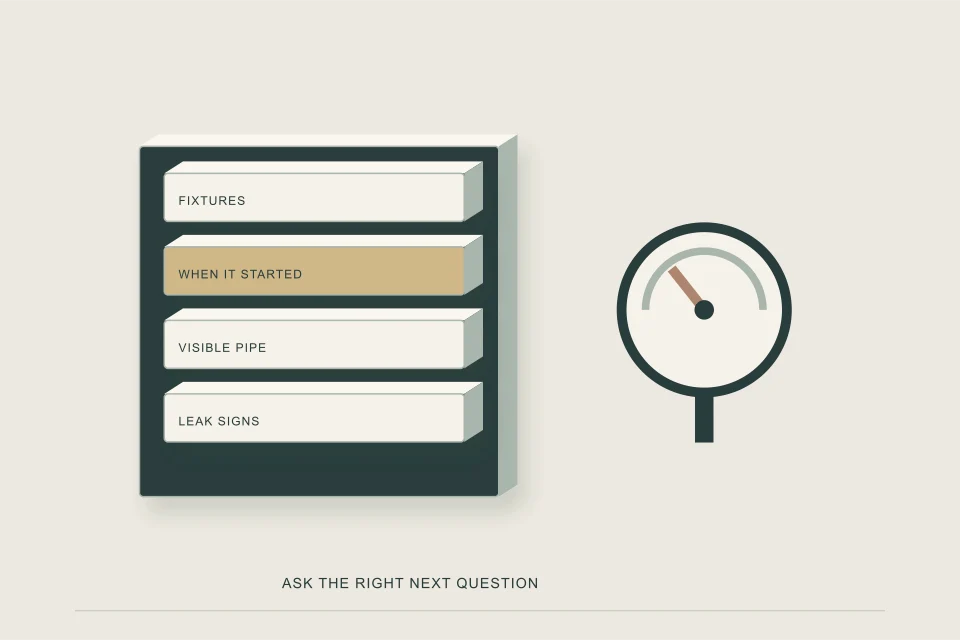
- Where it happens narrows the cause: one tap, hot only, upper floor or whole house each point to different parts.
- Pressure is measured with nothing running; flow is what arrives when a tap is open. They fail for different reasons.
- A sudden whole-house drop shared with neighbours is usually on the utility side.
- The City of Calgary suggests keeping a home between 40 and 60 psi; above about 80 psi the plumbing code calls for a pressure-reducing valve.
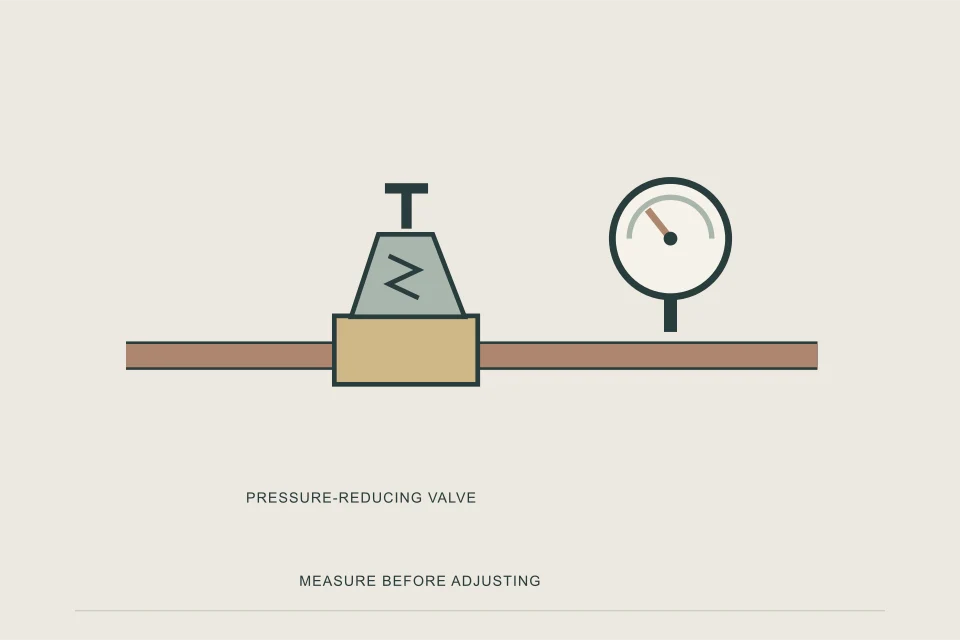
- Check the cheap things first: aerators, valves, the pressure-reducing valve and any softener bypass.
01 /Is it low pressure or low flow?
They sound the same at the shower, but they are different measurements with different causes. Static pressure is the push in the pipes with no water moving, set by the utility's system and any pressure-reducing valve. Flow is how much water actually arrives when a tap is open, and it falls whenever something in the path is narrow, rough or partly closed. A house can read a healthy static pressure and still deliver a weak shower, because the service or the house piping cannot carry enough water once it starts to move.
- Measure static pressure
Screw an inexpensive hose-thread pressure gauge onto a hose bib or laundry tap. Make sure nothing else in the house is running, open the tap and read the gauge.
- Measure flow
At the same tap, time how long it takes to fill a bucket of known size and work out litres per minute.
- Repeat with a second tap open
If the reading collapses when another fixture runs, the limit is flow, not supply pressure.
The City of Calgary suggests keeping household pressure between 40 and 60 psi in its advice on Poly-B piping. Winnipeg designs its mains for at least 207 kPa (30 psi) at peak hour. Toronto Water replaces its side of a service on an emergency basis when flow falls below 7 litres per minute. Those are useful markers, but your own utility's zone pressure is the one that counts, and Calgary's elevation range of almost 300 metres shows how much that can vary within one city.
02 /What if only one tap or only hot water is weak?
Then the service line is almost certainly not the cause. A single weak fixture is usually a clogged aerator or showerhead, or a fixture shut-off valve that is not fully open. Calgary and EPCOR both suggest unscrewing the aerator, soaking the screen in vinegar for 10 to 15 minutes, and noting that a fizzing screen means harmless mineral carbonate. EPCOR adds checking for a kinked supply hose under the sink and for low-flow fixtures that are working as designed.
- Hot water only: the water heater and its connections. Calgary sends hot-only problems to a plumber, and EPCOR to the water heater's manual. A recently replaced water heater with a partly closed valve is a common cause.
- Cold only: a water softener or filter on the cold supply. Put it in bypass and compare, as both utilities suggest.
- Outside hose bib only: the bib or its supply valve inside the wall.
- Upper floor only: pressure falls with height inside the house, and small risers or scaled pipe to that floor make it worse.
03 /What causes low pressure throughout the house?
Whole-house problems start where the water enters, and the order to check them runs from cheapest to most expensive.
| Cause | Typical pattern | Test |
|---|---|---|
| Main shut-off partly closed | Started after plumbing work or a shut-off | Open the valve fully; an old gate valve can break inside and stay partly shut |
| Pressure-reducing valve | Steady low pressure, or pressure that drifts high | Gauge reading against the valve setting; Calgary says a PRV over five years old may need service |
| Softener or whole-house filter | Low since the unit went in, or since the last cartridge | Put it in bypass |
| Galvanized house piping | Gradual decline; rusty water; old house | Compare the first tap after the meter with a far tap |
| Scaled or undersized service | Fine with one tap, weak with two or more | Good static pressure but poor flow at the meter end |
| Leak on the service | Meter moves with everything off; wet spot outside | Watch the meter for 15 minutes with all water off |
| Freezing service | Gradual drop in deep cold | Call the utility early |
| Utility side | Sudden, and neighbours have it too | Check the utility's outage map, crews or hydrant use |
Calgary also mentions irrigation: an active system with a leak can pull pressure down, and trapped air after the system is turned on in spring can make pressure uneven until the lines run for a while. The Low Water Pressure Diagnosis scores these causes for your symptoms and gives each test.
04 /Why did my water pressure drop suddenly?
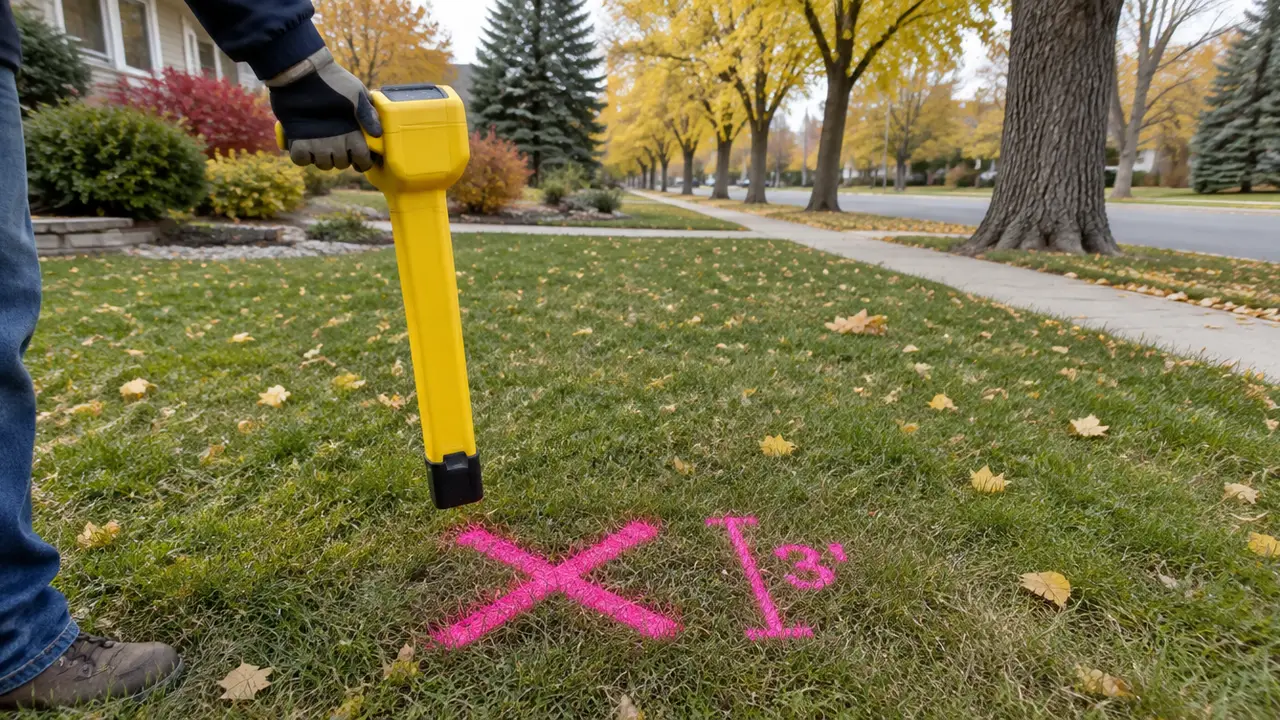
Ask a neighbour first. EPCOR's advice is that if a neighbour has not noticed a change, the problem is probably inside your home. A sudden drop shared along the street usually means utility work: a main break, main flushing, a hydrant being used, or maintenance. Calgary and EPCOR both publish maps or notices of work that can affect pressure. If only your house is affected, the usual suspects are a valve someone closed, a pressure-reducing valve that failed, or a new leak.
05 /Why does water pressure drop in winter?
A gradual drop during a cold spell can be the first sign of a freezing service. Calgary lists a gradual decrease in pressure in winter as a possible sign of frozen water lines, and EPCOR notes that lines inside the home can freeze from low temperatures, wind chill and drafts. Services laid shallow, or crossing under a cleared driveway where frost goes deeper, freeze first. Call the utility early rather than waiting for the water to stop entirely; the frost depth guide explains why some services are more exposed than others.
06 /When is the service line the problem, and what fixes it?
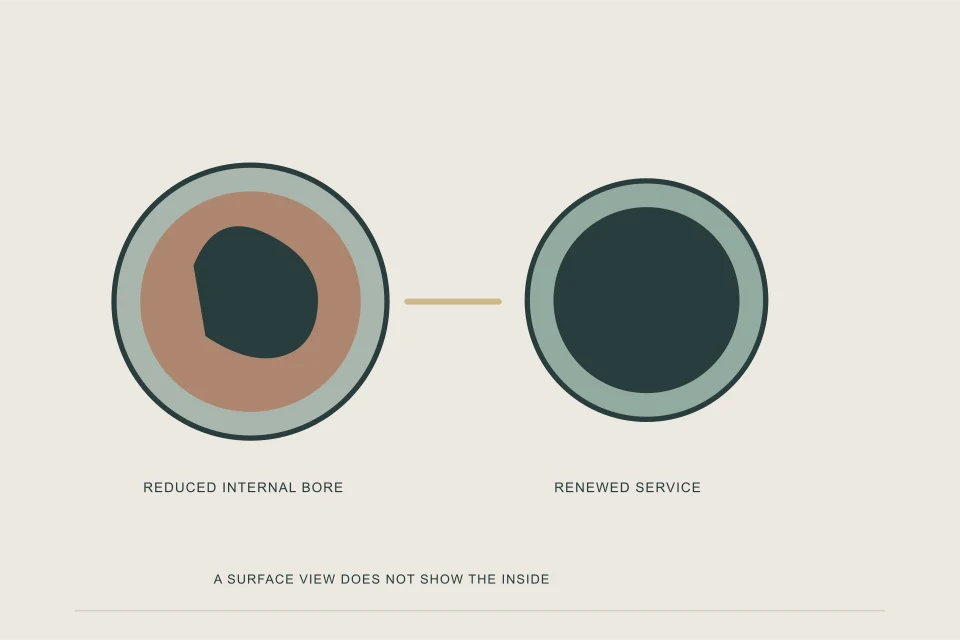
When static pressure at the meter end is fine but flow collapses as soon as two or three fixtures run, and the house piping has been ruled out, the service is the likely restriction. Old galvanized steel services scale shut from the inside, some older services are smaller than a modern house needs, and a crushed or kinked section can choke flow. The plumbing code sets 3/4 inch as the minimum service size, and some cities require more; Calgary's infill rules call for at least 1 inch.
- Scaled galvanized: replacement, not cleaning. See galvanized water lines.
- Undersized: a larger service, often combined with a renovation or suite; the utility may need to upsize its side too.
- Lead: replace both sides; see lead service line replacement.
- Booster pumps raise pressure but do not cure a restriction; fix the pipe first.
If pressure is too high rather than too low, the fix is a working pressure-reducing valve: see pressure-reducing valves. For replacement costs see the cost page, and to have someone measure and quote, send your details.
FAQQuestions people ask
What is normal water pressure for a house?
There is no single national figure. The City of Calgary suggests 40 to 60 psi, and the plumbing code calls for a pressure-reducing valve where static pressure at a fixture may exceed 550 kPa, about 80 psi.
Why is my water pressure low but there is no leak?
Most often a partly closed valve, a failing pressure-reducing valve, a clogged softener or filter, or scaled pipe. Check them in that order.
Why is water pressure low in the house but fine outside?
The hose bib is often the first branch after the meter. If it is strong and indoor taps are weak, look at the softener, filter, water heater or indoor piping.
Who do I call for low water pressure?
The utility if neighbours have it too or the drop was sudden; a plumber if it is only your house after the basic checks.
Can a clogged water meter cause low pressure?
It is possible but uncommon. The meter belongs to the utility, so ask them to check it rather than opening it yourself.
Can a water softener cause low pressure in the whole house?
Yes, on the water it treats. Calgary and EPCOR both suggest putting the softener in bypass; if pressure returns, the softener or its resin is restricting flow.
Why is pressure low right after the water was shut off for work?
Often because a valve was not fully reopened, or air and debris are trapped. Open the main shut-off fully and clean the aerators.
NETWORKGo deeper across the HAUSE Sewer network
What happens during a professional sewer cleaning visit
A step-by-step look at a professional sewer cleaning visit: arrival, questions, access, cleaning, flow testing, camera verification and the paperwork you keep.
DrainAugering.caHow to snake a bathtub or shower drain
How to snake a bathtub or shower drain: clear hair at the stopper, feed cable through the tub overflow, reach the shower trap, and spot a branch clog.
SewerInspector.caBeyond the camera: dye, smoke and pressure testing of sewer laterals
What sewer scope testing and lateral inspection can include beyond video: dye tests, smoke tests, air and water pressure tests, and when each one is used.