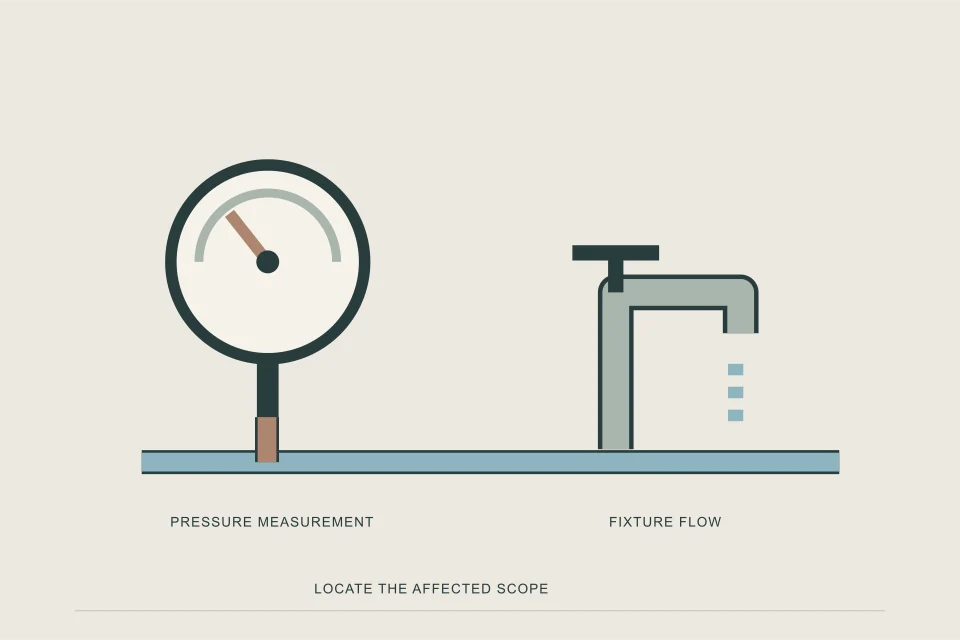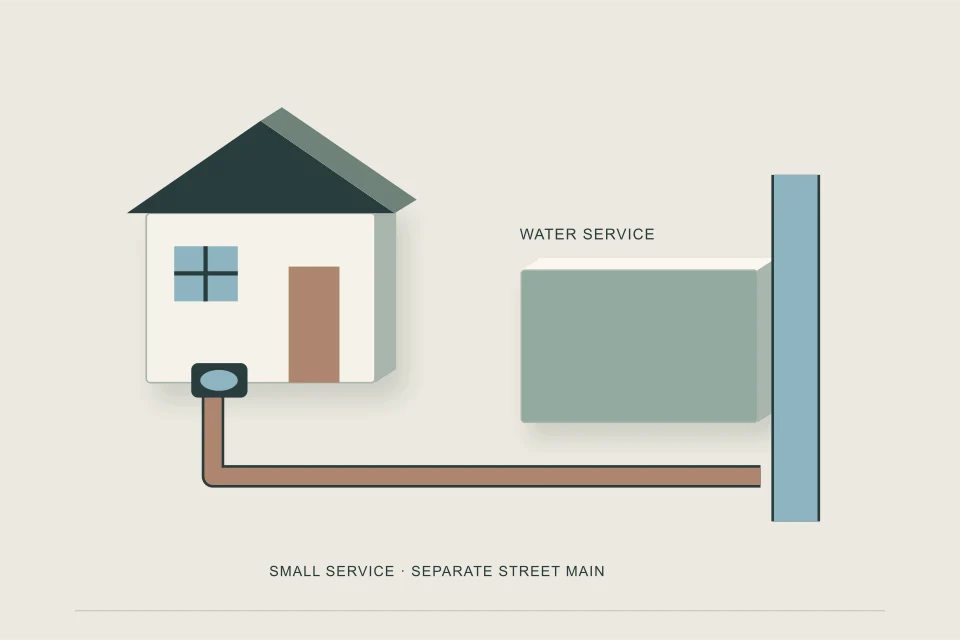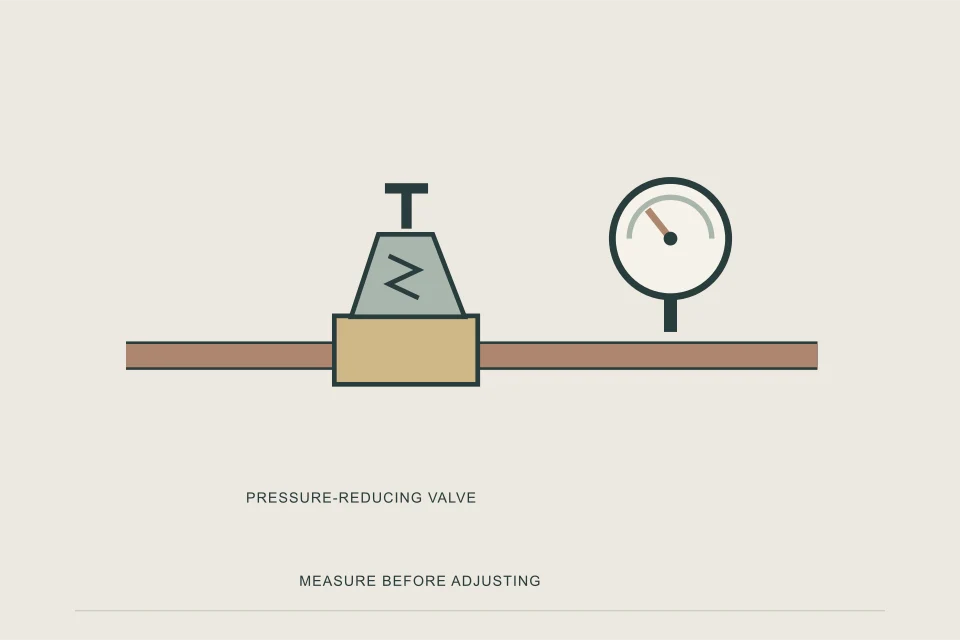
A pressure-reducing valve (PRV) is a spring-loaded valve on the water service, just after the meter, that lowers high street pressure to a set value for the house. The plumbing code calls for one where static pressure at a fixture may exceed 550 kPa, about 80 psi. PRVs wear out: a failing one can cause low pressure, or pressure that creeps too high. A gauge on a hose bib tells you which.
- The plumbing code requires a PRV where static pressure at any fixture may exceed 550 kPa (about 80 psi).
- The City of Calgary says homes built after 1990 in areas over 80 psi have a PRV, and a PRV over five years old may need service.
- A PRV closes the house off from the main, so the code also requires protection against thermal expansion, usually an expansion tank.
- A failing PRV shows up as low pressure, pressure that rises overnight, banging pipes or a dripping relief valve on the water heater.
- Adjusting a PRV is done at the valve following its maker's instructions, with a gauge attached to check the result.
01 /What does a pressure-reducing valve do?
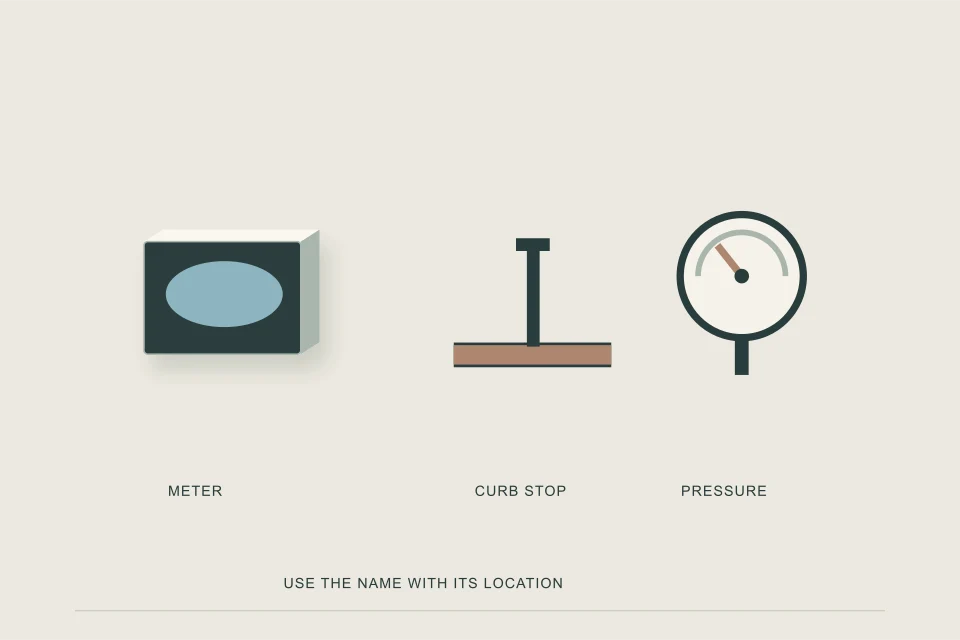
It takes the pressure the utility delivers and lowers it to a steady value the house plumbing can live with. Inside the valve, a spring pushes on a diaphragm that throttles an opening; as downstream pressure rises toward the setting, the diaphragm closes the opening down, and as taps open and pressure falls, it opens up again. The result is a steady household pressure whatever the street does. It sits just after the meter and main shut-off, and in most homes it is a bell-shaped brass body with an adjusting screw on top.
Street pressure varies a lot with elevation. The City of Calgary manages pressure zones across an elevation range of almost 300 metres and installs valves in its own system where pressure begins to exceed 100 psi. A house near the bottom of a zone can see much higher pressure than one near the top, which is why PRVs are common in some neighbourhoods and absent in others.
02 /When is a pressure-reducing valve required?
When pressure is high enough to need one. The plumbing code rule (Article 2.6.3.3 in the provincial codes based on the National Plumbing Code) says that where the static pressure at any fixture may exceed 550 kPa, a pressure-reducing valve must be installed to limit the maximum static pressure at the fixture to 550 kPa. 550 kPa is about 80 psi. The City of Calgary puts it in local terms: homes built after 1990 in areas of over 80 psi are equipped with a PRV.
| Figure | What it is | Source |
|---|---|---|
| 550 kPa (about 80 psi) | Static pressure above which a PRV is required | Plumbing code Article 2.6.3.3 |
| 40–60 psi | Range Calgary suggests for a home, in its Poly-B advice | City of Calgary |
| 100 psi (70 m) | Where Calgary installs pressure-control valves in its own system | City of Calgary |
| 1 psi ≈ 6.9 kPa | Conversion | Standard |
Your utility can usually tell you the typical pressure at your address. If your home has no PRV and a gauge reads above 80 psi with nothing running, that is worth a plumber's visit even if nothing has failed yet.
03 /How do I know if my PRV is failing?
By reading a gauge and watching how pressure behaves over time. The City of Calgary says high water pressure may be caused by a PRV that is over five years old and needs service. PRVs also fail the other way, sticking partly closed and starving the house.
- Low pressure throughout the house, with good pressure at a tap or hose bib before the PRV, if one exists there.
- Pressure that creeps up overnight on a gauge left on a hose bib, then drops when a tap opens.
- Banging or shuddering pipes (water hammer) that are new.
- A dripping temperature and pressure relief valve on the water heater, or a toilet fill valve that runs on its own.
- Pressure that swings as other fixtures open and close.
- Attach a gauge
Use a hose-thread gauge on a hose bib or laundry tap after the PRV.
- Read static pressure
With nothing running, compare with the valve's setting, if it is marked, and with the 40–60 psi range Calgary suggests.
- Leave it overnight
Some gauges have a maximum needle; a reading that climbs well above the setting points to a PRV that is not closing, or to thermal expansion.
- Open a tap
Watch how far pressure falls and how quickly it recovers.
The Low Water Pressure Diagnosis weights an older PRV more heavily and reads your gauge against these same markers.
04 /How do I lower the water pressure in my house?
If you have a PRV, it is adjusted at the valve: most have a screw or bolt under a cap on top, locked with a nut. Loosen the lock nut, turn the screw in small steps with a gauge attached to a nearby tap, and let the pressure settle between adjustments. Which direction raises or lowers pressure depends on the model, so follow the maker's instructions printed on the valve or published for it. If there is no PRV and pressure is high, one needs to be installed, which is plumbing work with a permit in many municipalities.
Lowering pressure does not cure a flow restriction. If your pressure is fine but water still arrives weakly with two taps open, look at scaled pipe or the service line; see low water pressure.
05 /Why does a PRV need an expansion tank?
Because a PRV, like a check valve or backflow preventer, stops water flowing back toward the main. When the water heater warms a tank full of water, that water expands, and with nowhere to go, pressure in the house climbs. The plumbing code therefore requires protection against thermal expansion wherever a pressure-reducing valve is required. The usual protection is a small expansion tank with an air cushion near the water heater. If your pressure spikes after the water heater runs, check that the expansion tank exists and has not lost its air charge.
06 /Does replacing the service line change the PRV?
Sometimes. A new, smooth service with less friction can deliver a little more of the street pressure to the PRV, and a larger service can deliver much more flow; both can reveal a PRV that was already struggling. When a service is replaced, the new main shut-off valve and the PRV are usually close together, so it is a good moment to have the PRV checked or replaced and the expansion tank confirmed. Ask for these as separate lines on the quote so you can decide on each.
- Ask the contractor to measure static pressure before and after the service replacement.
- Keep the old PRV only if it holds its setting on a gauge test.
- Confirm the expansion tank is present and charged.
Replacement steps are in the replacement process guide, and costs in the cost guide. If you want a plumber to test and quote, send your details.
07 /Repair, adjust or replace a pressure-reducing valve?
Adjust it if it still responds, rebuild or replace it if it does not. A valve that moves pressure when its screw is turned and then holds steady on a gauge overnight is working. One that ignores adjustment, creeps upward when nothing runs, or leaks from its body has failed. Some valves accept a cartridge or rebuild kit; many older ones are simply replaced.
| Symptom | Usual action |
|---|---|
| Pressure a little high or low, valve responds | Adjust to the target with a gauge attached |
| Pressure creeps up with no water use | Check the expansion tank, then the valve seat |
| No change when adjusted | Rebuild or replace the valve |
| Leaking body or bonnet | Replace |
| No PRV and static pressure above 80 psi | Install one; the code calls for it above 550 kPa |
Replacement is plumbing work that may need a permit, and it means shutting off the water at the main shut-off, which is a good moment to check that the main shut-off itself still works.
FAQQuestions people ask
At what pressure do I need a pressure-reducing valve?
The plumbing code requires one where static pressure at any fixture may exceed 550 kPa, about 80 psi.
How long does a pressure-reducing valve last?
It varies with water quality and pressure. The City of Calgary says high pressure may be caused by a PRV over five years old that needs service.
Can a bad pressure-reducing valve cause low water pressure?
Yes. A PRV that sticks partly closed or is set too low limits pressure for the whole house.
Where is the pressure-reducing valve in my house?
Usually just after the water meter and main shut-off, where the service enters. It often looks like a brass bell with a screw on top.
Do I need an expansion tank with a PRV?
The plumbing code requires protection against thermal expansion where a PRV is required; an expansion tank is the usual way.
Can I install a pressure-reducing valve myself?
It is plumbing work on the main supply and may need a permit. Most homeowners have a plumber install it, along with any expansion tank the code requires.
NETWORKGo deeper across the HAUSE Sewer network
Backwater valve installation: whether you need one, where it goes and how it is done
Should you install a backwater valve? When one is required, how it differs from a sump pump, how installation works, where it goes, costs and subsidies.
SewerJetting.caDo jetter nozzles for garden hoses and pressure washers really work?
Do jetter nozzles work? The physics of garden hose and pressure washer drain nozzles, what they can clear, where they fail, and how to judge product claims.
PipeCleaning.caWhat pipe do I have? Identify your drain pipe material
What pipe do I have? Identify a drain pipe from its look, joints, markings and house age, with a confidence rating, safe cleaning methods and camera advice.