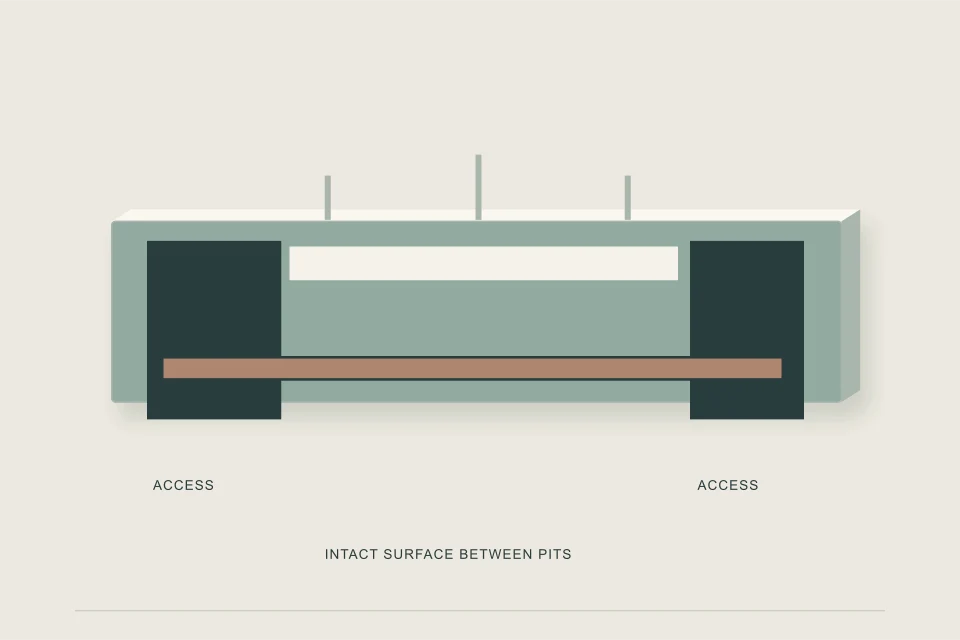
Trenchless water line replacement renews a house water service from two small pits, one near the curb stop and one at the foundation, instead of a trench across the yard. The old line is pulled out as the new one follows, split or burst in place, or left while a piercing tool or small directional drill makes a new path. It saves restoration on deep services and under driveways, but needs located utilities and a clear route.
- Every trenchless method still needs pits: usually one at the curb stop and one at the house.
- Pulling and splitting follow the old path; moling and boring make a new one.
- Deep prairie services, driveways, trees and landscaping are where trenchless saves the most.
- Nearby gas lines, rock, obstructions and a seized curb stop are the usual complications.
- The utility decides what may be done on its side, and some install their side themselves.
01 /How can a water line be replaced without digging a trench?
By working between two holes. A water service is small, fairly straight and often deep, which suits methods that move the pipe underground rather than exposing its whole length. A pit at the curb stop gives access to the utility connection; a pit or an opening at the foundation gives access to the entry. What happens between the two is the method.
| Method | How it works | Path | Old pipe |
|---|---|---|---|
| Pull-out and pull-in | A cable is fed through the old service and anchored to it; pulling draws the old pipe out while the new pipe follows into the same hole | Same as the old line | Removed |
| Splitting | A bladed head is pulled through the old metal pipe, slitting it and spreading it aside, with the new pipe attached behind | Same as the old line | Left split in the ground |
| Bursting | A cone breaks brittle pipe outward as the new pipe follows | Same as the old line | Left in fragments |
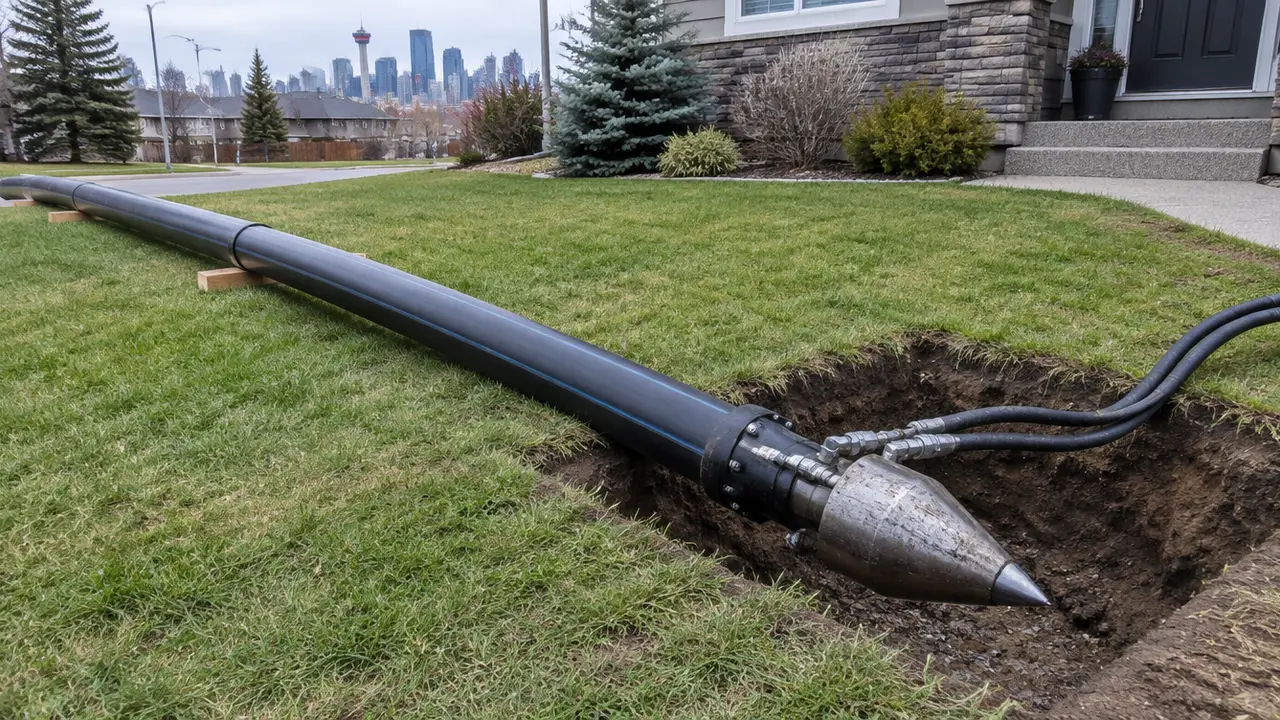
| Moling or small directional drilling | A pneumatic piercing tool is driven, or a small drill steered, between the pits; the new pipe is pulled back through | New | Abandoned or cut off at both ends |
Most house services are copper, lead or galvanized steel, which are ductile metals, so splitting and pulling are more common on water services than bursting, which suits brittle mains. Bursting in depth has its own site, PipeBursting.ca.
02 /When does trenchless make sense for a water service?
When the ground between the pits is expensive to open or restore, and when the service is deep. Prairie cities bury services very deep: Calgary requires 8.5 feet of cover, EPCOR puts new Edmonton services 2.59 to 2.89 m below grade at the property line, and Regina calls for at least 2.7 m. A trench that deep across a front yard needs protective systems and moves a lot of soil; two pits move much less. See the frost depth guide.
Trenchless is not automatically cheaper. On a short, shallow run under lawn, a trench may cost the same or less, because the pits are a large share of a trenchless price. Ask for both where the contractor offers both.
03 /Which method suits which old pipe?
The old pipe's material and condition decide whether it can be pulled or split, or whether a new path is easier.
| Old pipe | Behaviour | Likely methods |
|---|---|---|
| Lead | Soft and ductile | Pull-out and pull-in, or splitting; full removal preferred |
| Copper | Ductile | Splitting, pulling, or a new bored path |
| Galvanized steel | Ductile but often corroded and uneven | Splitting or a new path; pulling can snap corroded pipe |
| Polyethylene or other plastic | Flexible | Pulling, or a new path |
Lead is the special case. Health Canada says partial replacements are generally not recommended, so a trenchless job on a lead service should replace both the utility and private sides together wherever the program allows. Pulling the old lead out entirely, rather than leaving it split in the ground, is often preferred; ask what the utility requires. See lead service line replacement.
04 /What can go wrong with trenchless water line replacement?
Most problems come from what is near the service rather than the service itself. Water services often share space with gas services, and a piercing tool can wander off line in mixed ground. Locates and careful exposure of crossings are what prevent strikes.
- Utility locates first. Request locates through the provincial one-call service (Utility Safety Partners in Alberta, Ontario One Call in Ontario, and their counterparts elsewhere) with the notice it requires. Your private water line is not marked by them.
- Expose crossings by hand where the gas service or other lines cross the route.
- A seized curb stop can stop the job until the utility repairs or replaces it; ask the utility to exercise it beforehand.
- A stuck pull or split at a buried fitting, repair clamp or bend may need an extra pit; ask how an unplanned pit is priced.
- Heave or settlement near shallow surfaces, especially with moling; keep clear of foundations and slabs.
- The entry point: a new path may need a new foundation penetration, sleeve and seal.
05 /What happens on a trenchless replacement day?
- Before
Locates marked, curb stop confirmed working, pit locations agreed, water shut-off booked with the utility.
- Pits
A pit at the curb stop and one at the foundation, shored where depth requires.
- Shut off and cut
Water off at the curb stop; the old service is cut at both ends.
- Replace
The new pipe is pulled, split in or pulled back through the bored path.
- Connect
New connection at the curb stop, a sealed foundation entry, and a new main shut-off inside.
- Test and flush
Pressure-tested for leaks and flushed before use; lead work gets extra flushing and follow-up testing.
- Restore
Pits backfilled and the surfaces restored as agreed.
The full project sequence, including permits and paperwork for city programs, is in the replacement process guide. Pipe choices are compared in copper, PEX or polyethylene.
06 /How much does trenchless water line replacement cost?
No Canadian utility we checked publishes a trenchless-specific price. The savings come from restoration: two pits instead of a full-length trench through a driveway or landscaping. The published references for service replacement in general, and the drivers that set where a job falls, are on the cost page.
When you ask for quotes, ask each contractor to state the method, the pit locations, the new pipe and size, what happens to the old pipe, and the price of an unplanned pit. You can send your details to start.
07 /How are the pits placed for a trenchless water service?
Usually one at the curb stop and one at the house, with more only where something forces it. The curb stop pit exposes the utility connection and the valve; the house pit exposes the service where it meets the foundation, or the connection is made from inside the basement through the wall. The pits have to be deep enough to reach the service, which on the prairies means well over two metres, so shoring is part of the plan.
- Extra pits go where the old line has a buried fitting, repair clamp or sharp bend that a pull or split cannot pass.
- Driveway crossings are usually spanned by the pull, not dug.
- Spoil from each pit needs somewhere to go and is backfilled in layers afterwards.
- The curb stop may be replaced while its pit is open, at the utility's direction.
Ask for a sketch of the pit locations with the quote, and for the price of any unplanned pit. The sketch also helps you protect plants, fences and sprinklers before the crew arrives.
FAQQuestions people ask
Is it possible to renew my water service without trenching the front yard?
Often, yes, from a pit at the curb stop and another at the house. The yard between them is left undisturbed.
What is moling a water pipe?
Driving a pneumatic piercing tool through the soil from one pit to the other to make a path, then pulling the new pipe back through.
Is trenchless water line replacement cheaper than digging?
Often when the route crosses driveways, trees or landscaping, or when the service is deep. On a short lawn run a trench can cost the same or less.
Can a lead water pipe be pulled out without digging?
Yes, lead is soft enough to be pulled out as the new pipe follows, from pits at each end. Replace both sides together where possible.
Do I need locates for trenchless work?
Yes. Public utilities must be located through the provincial one-call service before any digging, and your private line needs its own locate.
NETWORKGo deeper across the HAUSE Sewer network
Trenchless lining vs pipe bursting: cost, fit and trade-offs
Trenchless lining vs pipe bursting cost in Canada: 2026 CIPP and bursting ranges in CAD, line items, which defects each fixes and how to choose.
SewerInspector.caSewer scope inspections in Edmonton: what to expect and who to call
Sewer scope and sewer line inspection in Edmonton: what mature and newer neighbourhoods show on camera, cold and clay soils, elms, EPCOR and 311 checks.
SewerRoots.caSewer-safe trees and shrubs to plant near a sewer line
Sewer-safe trees and shrubs for Canadian yards: small, slow, prairie-hardy species to plant near sewer lines, what to put over the trench, and what to avoid.