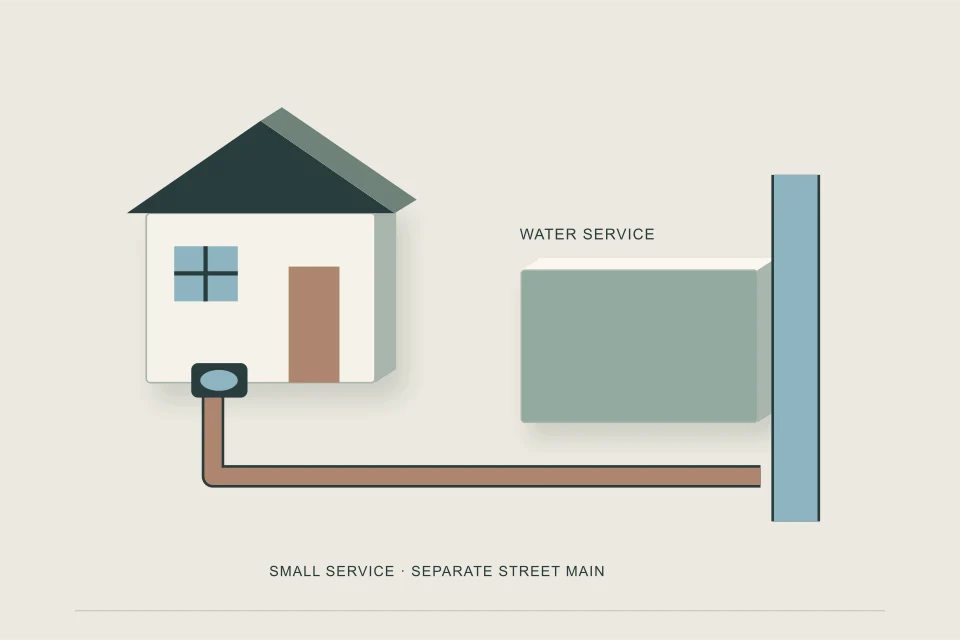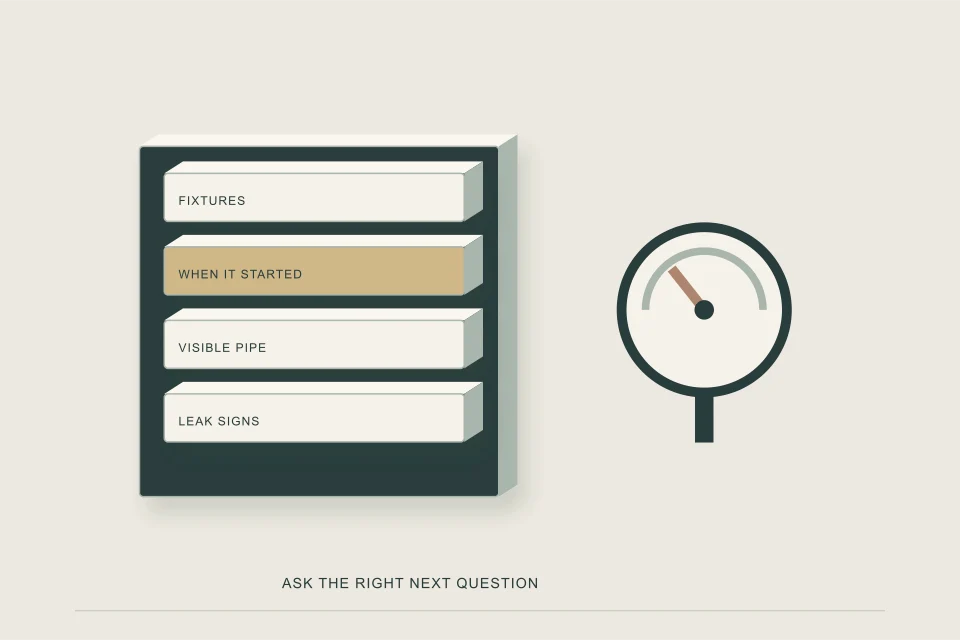
The Low Water Pressure Diagnosis ranks the likely causes of weak water pressure in a house from the symptoms you enter: which taps, how it started, whether neighbours have it, the pipe you can see, a pressure-reducing valve, a softener and any leak signs. It reads an optional gauge and flow measurement against published thresholds and gives a specific test for each cause, from the aerator to the service line.
- Where the problem shows up narrows the cause fastest: one tap, hot only and whole house point to completely different parts.
- A sudden drop shared with neighbours is usually on the utility side; a gradual drop in one house usually is not.
- Static pressure and flow are different measurements: good pressure with poor flow means something is restricting the pipe.
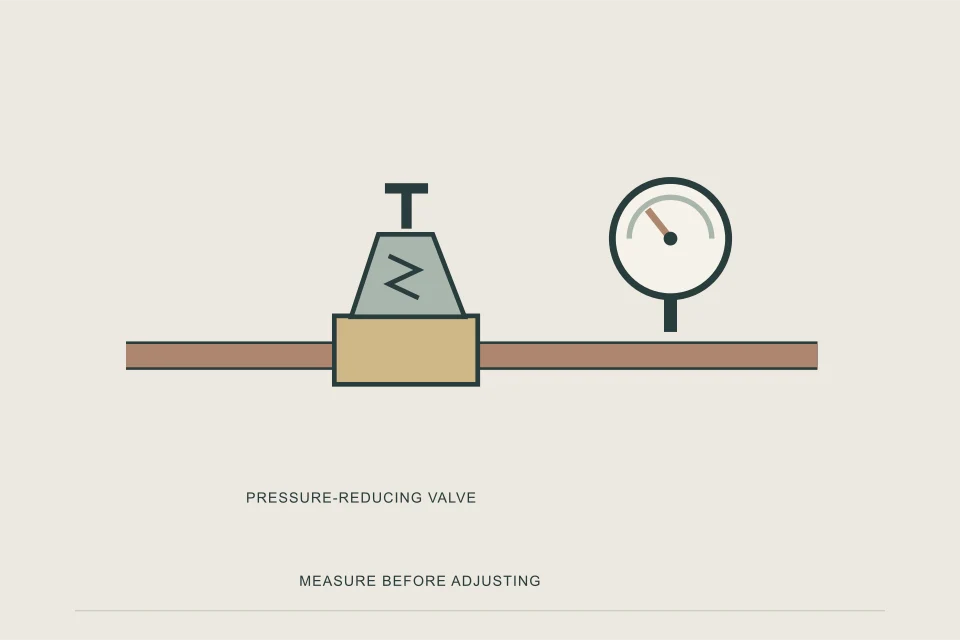
- Above about 80 psi (550 kPa), the plumbing code calls for a pressure-reducing valve, so a very high reading is its own problem.
- The tool ranks causes; a plumber's gauge readings at several points confirm them.
Low Water Pressure Diagnosis
01 /What does the pressure diagnosis do?
It turns a vague complaint, "the water pressure is bad", into a short ranked list of causes, each with a test you can do or ask for. Water pressure problems in a house come from a small set of places: the fixture, a valve that is not fully open, a pressure-reducing valve, scale inside old steel pipe, the service line from the street, a leak, a softener or filter, the water heater, freezing, or the utility's own system. Each leaves a different pattern, and the tool scores the pattern you describe.
The troubleshooting order follows what utilities themselves publish. The City of Calgary and EPCOR in Edmonton both start with the aerator, the fixture shut-off valves and the main shut-off valve, then the pressure-reducing valve, a water softener bypass, irrigation, maintenance work nearby and frozen lines; both send hot-water-only problems to the water heater or a plumber. The tool puts those same checks into a ranked order for your symptoms.
02 /Which symptoms does it score?
Every answer adds points to one or more causes. The highest totals are shown first, up to four, with the reasons that added points and a test for each.
| Your answer | Cause it points to | Points |
|---|---|---|
| One tap or shower | Aerator, showerhead or fixture valve | 5 |
| Hot water only | Water heater or its connections | 5 |
| Outside hose bib only | The hose bib or its supply | 5 |
| Upper floor only | Elevation and pipe size to that floor (+2 to galvanized if you have it) | 4 |
| Cold only | Softener or filter (3 with one, 1 without); main shut-off | 1–3 |
| Whole house, after work or a shut-off | Main shut-off not fully open | 5 (otherwise 2) |
| Whole house, PRV over five years old | Pressure-reducing valve | 4 (2 if newer; 1 if unknown, or 2 when unknown in a house built after 1990) |
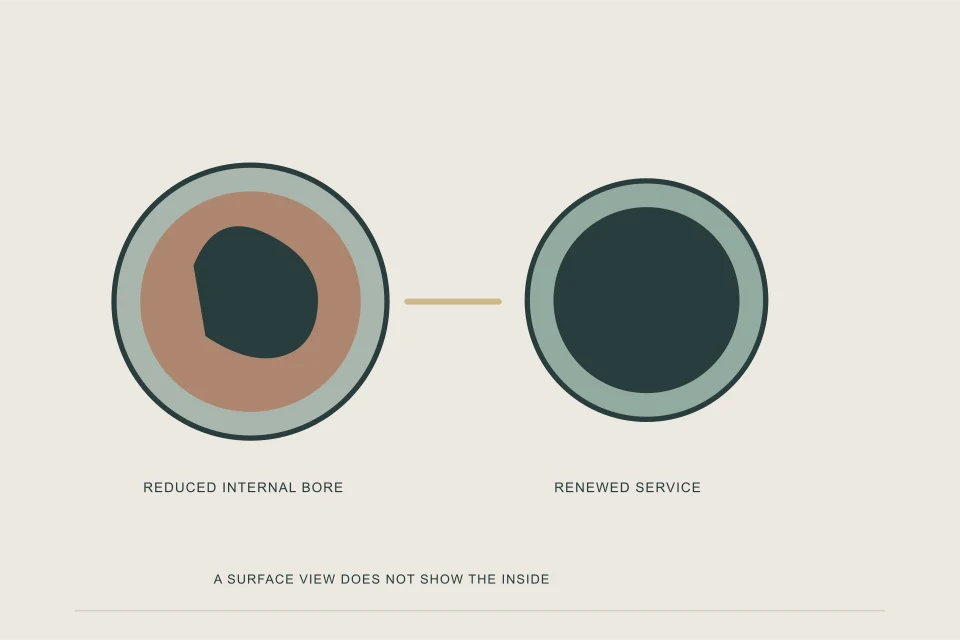
| Whole house, galvanized pipe | Scaled galvanized pipe inside | 4 (2 if built before 1960 and pipe unknown) |
| Gradual, always weak, or weak only with several taps | Scaled or undersized service line | 2 each (+1 if built before 1960) |
| Softener or whole-house filter | Softener or filter restriction | 3 |
| Sudden, neighbours too | Utility side | 6 (3 if you do not know; 4 if not sudden; −3 if neighbours are fine) |
| Gradual in cold weather | Service starting to freeze | 5 |
| Wet or sinking spot along the service | Leak | 6 (meter moving 5, high bill 3) |
The weights are editorial, set so that a symptom that isolates one location, such as hot water only, outranks a general risk factor, such as the age of the house. The PRV age of five years comes from the City of Calgary, which says a PRV over five years old may need service; the pre-1960 marker for galvanized pipe also comes from Calgary, which says galvanized was commonly installed before 1960 and corrodes from the inside out.
03 /How does it read a gauge or flow measurement?
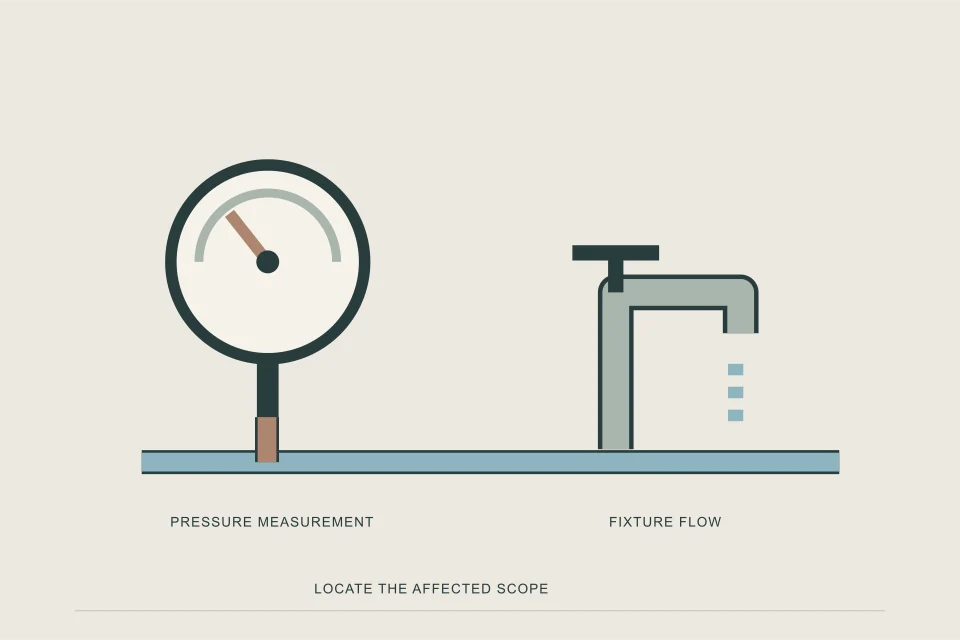
Two optional numbers make the result much sharper. Static pressure is read with a gauge on a hose bib or laundry tap while nothing else in the house runs. Flow is timed by filling a bucket of known size at the same tap. The tool converts psi to kilopascals (1 psi is about 6.9 kPa) and places your reading in one of five bands.
| Reading | What the tool says | Reference |
|---|---|---|
| Over 80 psi (about 550 kPa) | High, not low: check the pressure-reducing valve | Plumbing code Article 2.6.3.3: a PRV where static pressure at a fixture may exceed 550 kPa |
| 60–80 psi | Above the range Calgary suggests, below the code trigger | City of Calgary: keep pressure between 40 and 60 psi (Poly-B advice) |
| 40–60 psi | Inside the range Calgary suggests; weak flow means a restriction | City of Calgary |
| 30–40 psi | Below that range; check the PRV and main shut-off first | City of Calgary |
| Under 30 psi | Call the utility, then check the valves | City of Winnipeg designs mains for at least 207 kPa (30 psi) at peak hour |
For flow, the tool uses one published line: Toronto Water replaces its side of a service on an emergency basis when flow falls below 7 litres per minute. A reading under 7 L/min is flagged as a reason to call the utility. And when static pressure is 40 psi or more but flow is under 7 L/min, the tool adds that this combination is the signature of a restriction: a scaled or undersized pipe, a partly closed valve, or a clogged filter. The low pressure guide explains how to take both readings.
04 /What tests does it recommend?
Each cause carries one test, written so you can do it or ask for it. Most take minutes and need no tools beyond a bucket, a watch and, ideally, an inexpensive hose-thread pressure gauge.
- Fixture: unscrew the aerator or showerhead and soak the screen in vinegar for 10 to 15 minutes; check the valves under the fixture are fully open.
- Main shut-off: open it fully; an old gate valve can fail internally and stay partly closed, which a plumber fixes by replacing it. See the replacement process guide for the valves along the service.
- Pressure-reducing valve: read static pressure and compare it with the valve's setting; see pressure-reducing valves.
- Galvanized pipe: compare the first tap after the meter with a far tap; a big difference points to the house piping. See galvanized water lines.
- Service line: good static pressure with weak flow at the meter end, and clean inside piping, points at the service.
- Leak: with every tap and appliance off, watch the meter for 15 minutes.
- Softener or filter: put it in bypass and compare.
- Utility side: check for crews, a main break or hydrant use, and ask a neighbour.
- Freezing: a gradual drop in cold weather is an early warning; call the utility and read frost and water lines.
05 /What can the tool not tell me?
It cannot measure anything, and it does not know your utility's zone pressure or the size of your service. It also treats city water only: on a private well, pressure comes from the pump and pressure tank, which have their own failure patterns. If you tick Poly-B, the result adds the City of Calgary's note that it was installed between 1978 and 1995, that it is not necessary to replace it if you have had no problems, and that pressure should be kept between 40 and 60 psi; more is in the Poly-B guide.
- Two causes often stack, such as a half-open main valve on a scaled service; fix the cheap one and measure again.
- A result pointing at the service line is a reason for measurement, not for replacement; a plumber should confirm with readings at the meter and at fixtures.
- If pressure is very high rather than low, the fix is a working pressure-reducing valve, not a bigger pipe.
- If you smell gas, see water near electrical equipment, or have a burst, stop and call the right emergency line first.
If the diagnosis points to the service line, the materials guide and the cost page cover what replacement involves. To have a contractor measure and quote, send the details with your readings.
FAQQuestions people ask
What water pressure should a house have?
There is no single national number. The City of Calgary suggests keeping a home between 40 and 60 psi, and the plumbing code calls for a pressure-reducing valve where static pressure at a fixture may exceed 550 kPa, about 80 psi.
How do I measure my water pressure?
Screw a pressure gauge onto a hose bib or laundry tap, make sure nothing else is running, open the tap and read it. That is static pressure.
Why is my pressure fine with one tap but weak with two?
That pattern usually means a flow restriction, such as scaled pipe, an undersized service or a partly closed valve, rather than low supply pressure.
Does the tool work for a house on a well?
No. Well systems depend on the pump and pressure tank, so the ranking here does not apply.
Who fixes low pressure caused by the city?
The utility. If neighbours share a sudden drop, report it through 311 or the utility's line rather than calling a plumber first.
NETWORKGo deeper across the HAUSE Sewer network
What is hydro jetting in oil and gas, and how does it differ from sewer jetting?
What is hydro jetting in oil and gas? How industrial hydro blasting differs from sewer jetting in pressure, tools and safety, plus hydrovac and sewer careers.
DrainAugering.caClog Locator: find the blockage before you pick up a cable
Use the Clog Locator to find where a drain clog sits (trap, branch, stack, main or lateral) and which auger class and cable size fits the pipe.
SewerInspector.caSewer line locating and depth: how the mark on your lawn is made
How sewer line locating and depth readings work: the sonde, the hand-held locator, peak and null readings, marking, accuracy, and calling before you dig.