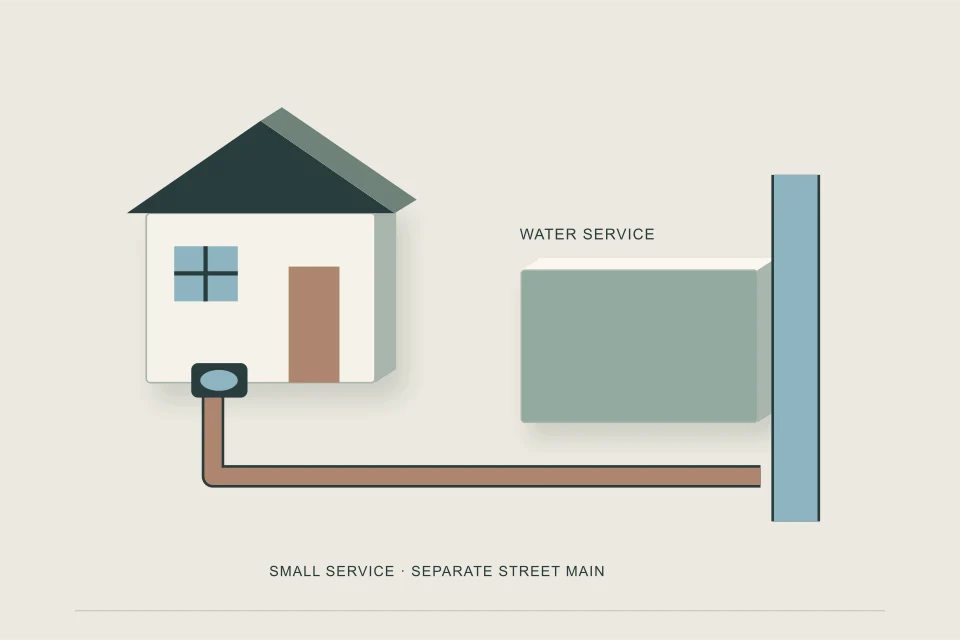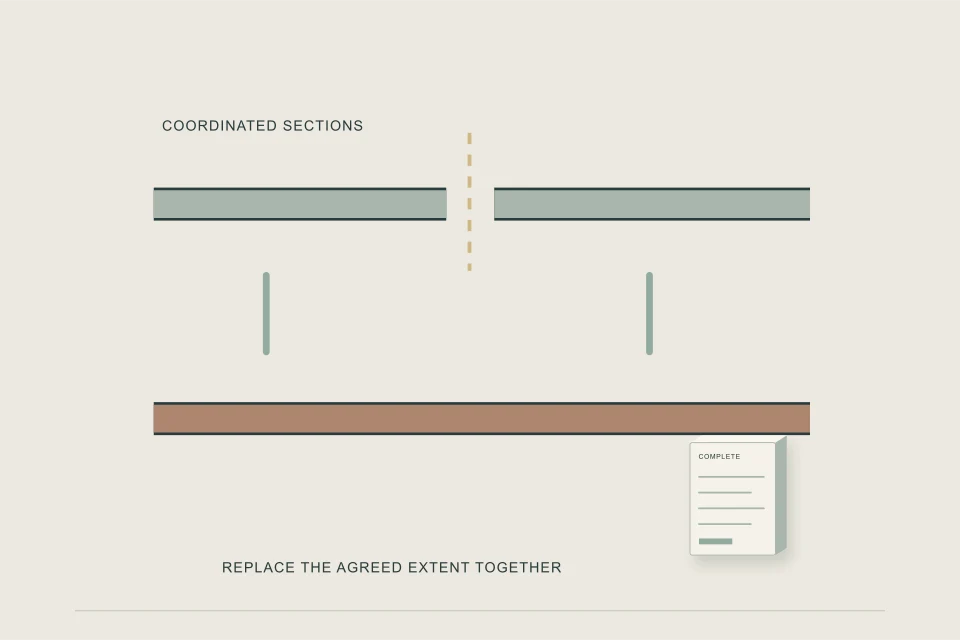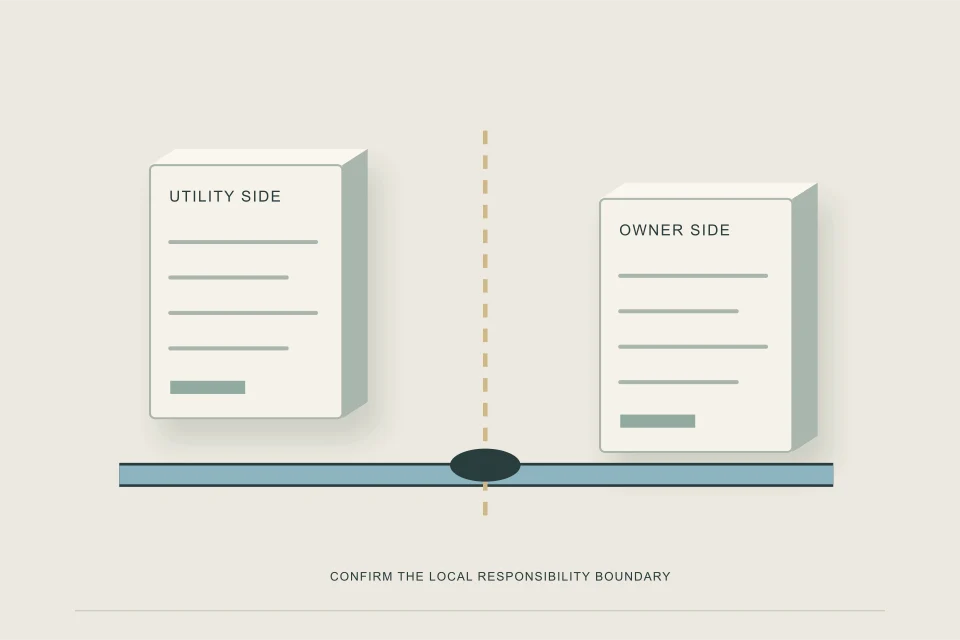
In most Canadian cities the utility pays to repair the water service from the main to the property line or curb stop, and the homeowner pays for everything from there into the house. Calgary, for example, says the owner pays all repair costs on private property except the meter. Home insurance generally covers sudden water damage, not replacing a worn-out buried pipe, though some insurers sell service line coverage.
- The ownership split, usually the property line or curb stop, decides who pays for a leak.
- Utilities usually own the meter and often the curb stop, even when they sit on private property.
- A leak on private property is the owner's to repair; Vancouver bills its crew time when a leak turns out to be private.
- Standard home insurance is aimed at sudden water damage, not at replacing a buried pipe that wore out.
- Lead replacement is the exception where cities often pay part or all of the private side.
01 /Where does the city's responsibility stop?
At a line each utility defines, usually the property line or the curb stop near it. On one side the utility maintains and repairs the pipe; on the other, the owner does. The details differ enough that it is worth reading your own utility's wording.
| City | Utility is responsible for | Owner is responsible for |
|---|---|---|
| Calgary | Main to property line; the service valve, even on private land; the meter | Property line to house; all repairs on private property except the meter |
| Edmonton | Main to property line; the curb stop; the meter | Property line to the meter in the home |
| Winnipeg | The shut-off valve and the pipe to the main | Home to the shut-off valve |
| Ottawa | Shut-off valve to the main | Home to the shut-off valve |
| Toronto, Hamilton, Regina, London | Main to property line | Property line into the home |
| Montréal | Main to property line | Property line to the interior shut-off valve |
| Kingston | Main to property line, including the curb stop; the meter | All other piping on private property |
| Vancouver | Main to property line, including the shut-off valve | Leaks on private property |
02 /Who pays for a leaking water service line?
Whoever owns the leaking part. The hard part is knowing which side the leak is on before you call anyone. The City of Vancouver says it covers the cost of repairing leaks on City property only, and that it bills its service call time, $126 an hour during regular hours or $252 after hours or in an emergency, to the owner when the leak is on private property. Regina says a leak on private property is the owner's responsibility to repair.
- Confirm there is a leak
With every tap and appliance off, watch the meter for 15 minutes. Any movement means water is escaping.
- Look for where
A wet, green or sinking strip between the house and the street, water at the curb box, or dampness at the foundation entry.
- Call the utility first
If the leak may be at or beyond the curb stop, the utility can check its side and tell you where its responsibility ends.
- Then a plumber
If the leak is on your side, get a repair or replacement quote.
Should a leak be repaired or the line replaced? A single leak on sound pipe is usually repaired. A leak on lead is a different matter: Winnipeg advises replacing a lead pipe rather than repairing the leak. Corroded galvanized steel tends to leak again. The cost page covers repair versus replacement.
03 /Does home insurance cover a broken water line?
Usually for the damage, rarely for the pipe. Standard home policies are written around sudden and accidental escape of water, typically from plumbing inside the house, and generally exclude wear, corrosion and gradual deterioration. A buried service that has corroded until it leaks is the kind of loss a standard policy tends not to pay to replace, although resulting water damage inside may be covered depending on the wording.
- Read the water damage wording and the exclusions for wear, deterioration and gradual leakage.
- Ask about service line coverage, an optional endorsement some insurers sell for buried service lines.
- Ask in writing whether the pipe, the excavation and the restoration are covered, and at what deductible.
- Document everything: photos, the meter test, the utility's findings and the plumber's report.
Insurers also ask about older piping materials such as Poly-B; see Poly-B water lines.
04 /Who pays when a water service freezes?
The same split applies: a freeze on the utility side is the utility's, and a freeze on the private side is the owner's, in most cities. Some utilities run specific frozen-service programs, as Utilities Kingston does, so call the utility first when water slows or stops in deep cold. For chronic cases, Guelph's private-side grant covers lines with a history of freezing. See frost and water line depth.
05 /Does the city pay to replace a lead service line?
Always for its own side, and sometimes for yours. Lead is where cities are most willing to help with the private side, because a lead line left in place undoes the benefit of replacing the public side.
| Arrangement | Cities |
|---|---|
| Utility pays for both sides, up to a limit | Halifax (up to $20,000 per replacement) |
| Cost shared | Saskatoon (owner 40%) |
| Grant toward the private side | Québec City (up to $2,500), Guelph (up to $2,000) |
| Financing for the private side | Hamilton (water bill loan), London (tax bill loan), Regina (interest-free deferral), Montréal (15-year payment) |
| Owner pays the private side | Toronto, Calgary, Edmonton, Winnipeg, Ottawa (with a rebate for private-only replacement) |
Details are on the city programs page and in lead service line replacement.
06 /What should I do if the utility and I disagree about the leak?
Ask the utility to show where its responsibility ends at your address and what it found on its side, and ask your plumber for the same in writing, with photos of the exposed pipe. A leak exactly at the curb stop is a common point of dispute, because in many cities the utility owns the valve even when it sits on private land. Written findings from both sides, and a photo of the leak once exposed, usually settle it.
- Get the utility's ownership rule for your address in writing.
- Keep the meter test result and photos of any wet area.
- Have the leak exposed and photographed before it is repaired.
- Keep all invoices and the utility's reports for any claim.
For the parts and valves involved, see what a water service line is. For quotes on a private-side repair or replacement, send your details.
07 /What about shared or unusual services?
Some older properties do not have one service per house. Two houses may share a single service that splits on private land, or a service may cross a neighbour's lot to reach the street. Hamilton, for example, requires any shared-service interconnection to be removed before it replaces the public portion of a lead service. Responsibility for a shared line depends on the utility's bylaw and any easement or agreement between the owners.
- Ask the utility whether its records show a shared service at your address.
- Check your title for an easement covering a pipe across a neighbour's land.
- Talk to the neighbour before any work; one shut-off may cut water to both houses.
- Plan separation if the utility requires it; each house then gets its own service and curb stop.
Lane-serviced homes are another variation: the curb stop and the utility side may be at the back, under a lane, which changes where crews dig and which surfaces are restored. EPCOR notes its curb stop can be in the back alley. Knowing this before a leak saves time when you call.
FAQQuestions people ask
Is the water line from the street to the house the homeowner's responsibility?
Usually the part from the property line or curb stop to the house is. The utility is usually responsible from the main to that point.
Who owns the water meter?
The utility, in most cities, even though it is inside your house. Calgary, EPCOR and Kingston all say so.
Does homeowners insurance cover water line replacement?
Standard policies generally do not pay to replace a worn-out buried pipe. Some insurers sell service line coverage; ask in writing.
Who pays if the leak is at the curb stop?
Often the utility, since many utilities own the curb stop even on private land. Confirm your utility's rule.
Will the city charge me to check for a leak?
Some do if the leak is on private property. Vancouver, for example, bills its service call time to the owner in that case.
Who pays if a neighbour shares my water service?
It depends on the utility's bylaw and any easement between the owners. Hamilton, for one, requires shared interconnections removed before it replaces a lead public side.
NETWORKGo deeper across the HAUSE Sewer network
Who pays for sewer repair: buyers, sellers, landlords, tenants and condo owners
Who pays for sewer repair in Canada: buyer vs seller, landlord vs tenant, condo corporation vs unit owner, and neighbours who share one sewer lateral.
SewerRoots.caWhose tree, whose pipe: who pays when roots block a sewer line
Who is responsible when a city or neighbour's tree sends roots into your sewer line: the general Canadian pattern, the evidence, and how to raise it.
SewerCleaners.caWhat causes sewer backup, and how to tell which cause is yours
What causes sewer backup: roots, grease, wipes, sags, broken pipe, frozen lines and rain-overloaded city sewers, plus how to tell which one caused yours.